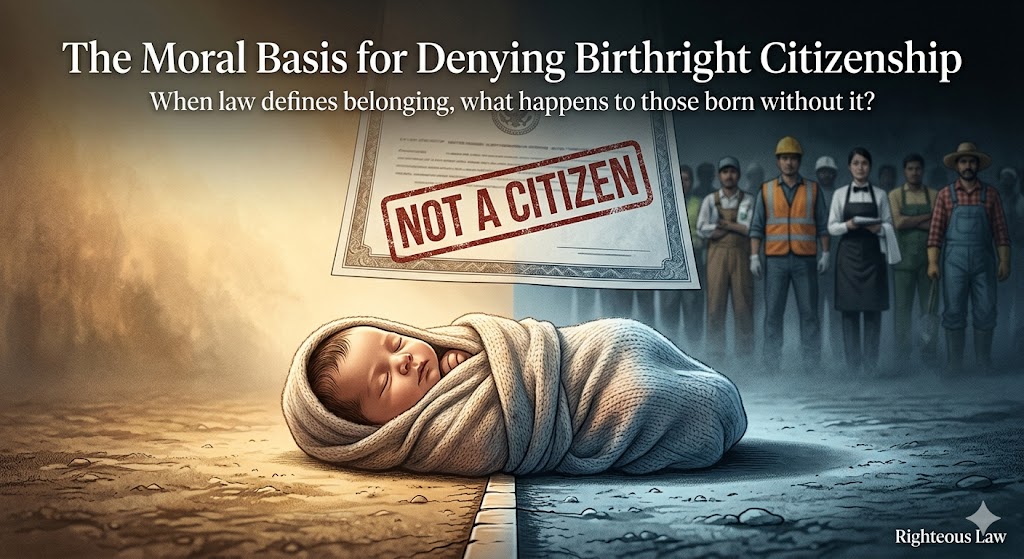
Is there a moral basis for denying children birthright citizenship[?
Introduction
On 1st January 2006 an amendment to New Zealand’s citizenship laws removed the rights of some children born in New Zealand to New Zealand citizenship, requiring instead that the child must have at least one parent either a New Zealand Citizen or New Zealand resident. Consequently, an unknown number of children were both after the law change who were unable to regularise their immigration status, usually due to their parents being unlawfully in New Zealand, and therefore liable for deportation. The eldest of the children in this situation are now 19 years old, entering adulthood and face deportation despite never having lived in any other country apart from New Zealand.
I will examine the possible justification for depriving children of the rights that come with citizenship status, and whether or not the basis for the differing treatment of children born in New Zealand is morally significant. In analysing the possible justifications I will examine first the consequentialist arguments, upon which the law change appears to have been predicated. Second, I will examine two types of rights based arguments, which I have divided into arguments on the one hand in favour of the state and its citizens in depriving some children of citizenship rights, and on the other hand, the rights of the children, their parents and their wider community in obtaining citizenship upon birth.
I will conclude that the justifications behind the law change fails the basic legitimation demand of justification in both consequentialist and rights based arguments, and therefore both the deprivation of citizenship rights, and the coercive actions of deportation of such children are arbitrary and unable to be morally justified.
Assumptions
Out of necessity, I must focus on one very narrow issue and therefore I have made a number of assumptions that form the basis of this ethical examination:
- First, I will assume the statist position that New Zealand has a right to enforce its immigration restrictions. A cosmopolitan argument for open borders by necessity would include the right to birthright citizenship, an issue beyond the scope of this essay.
- Second, for practical purposes I will ignore the distinction between New Zealand citizenship and New Zealand residency status and will simply refer to birthright citizenship as including any permanent immigration status enabling the child to remain indefinitely in New Zealand.
- Third, I will ignore the difference between children born to irregular migrants in New Zealand and children born to temporary visa holders in New Zealand as the assumption is that a child should not be held responsible for the actions of the parent and therefore the question of whether children should inherit the ‘sins’ of the parent are beyond the scope of this essay.
- Fourth, I am assuming that deportation and depriving a child of entitlements that New Zealand citizen children have, such as healthcare and education are both harmful to the child.
- Finally,my argument and conclusions are based on the assumption that if a child faces potential harm from the state, through either deportation or the deprivation of education and healthcare rights, then the state has an obligation to justify those actions and cannot act arbitrarily when inflicting harm on a child living within its borders, especially as the enforcement of immigration regulations can cause significantly more harm than the enforcement of other types of regulation.
Therefore, I will examine the justifications for the deprivation of citizenship to children born in New Zealand and assess whether the grounds for distinguishing between children are morally justifiable.
Consequentialist Arguments
I will examine two types of consequentialist argument; the first being those relating to the potential for birthright citizenship to be abused by those seeking to ‘cheat’ the system, arguments which I argue were the sole basis for the deprivation of citizenship, and broader consequentialist arguments often used to argue against a more open and liberal immigration system.
In New Zealand, it has been suggested by legal academics that the amendments to New Zealand birthright citizenship laws was out of fear that lower courts were tempted to recognise the supremacy of the rights of the New Zealand citizen child over the rights of the state to deport parents unlawfully in New Zealand Such rights exist in international conventions to which New Zealand is a signatory but also, some judges at the lower court level were starting to reference common law rights for the protection of children. As it turned out however, the New Zealand Supreme Court in a line of decisions culminating in the Ye decision in 2009 made such rights ultimately subservient to the rights of the state to enforce its own immigration rules, but the fear of a floodgate of birth tourists is palpable in the Supreme Court decision with, for example, the majority decision in Ye expressing fear that privileging the parenthood of New Zealand citizen children creates an incentive for irregular migrants to “hide for as long as you can and have as many children as you can”
It has also noted, quite correctly, that this fear overlooked the near impossibility of a New Zealand citizen child opening doors for the parent to obtain a Resident Visa Considering this near impossibility, a clear comparison must be made to the fear of ‘birth tourism’ in the United States where agencies actively market birth tourism services to pregnant women around the world. Such a concept would be unlikely work in New Zealand, as such a purpose of travel is unlawful and the application would be declined and even in the USA, the numbers are negligible.
This then also negates a potential ‘floodgates’ argument If the evidence from the USA is that birth tourism has a negligible effect on its irregular migrant numbers, in a country that allows travel for the purposes of giving birth, and with a porous land border, then it’s even less of a valid argument in New Zealand which does not allow visitors to enter for the purpose of giving birth and has possibly the most formidable border in the world, being a country almost impossible to reach other than by air travel.
Much of the literature in the field of political philosophy however focuses on open border arguments, and therefore I will survey the standard consequentialist arguments against open borders to determine whether any of these are applicable to the deprivation of birthright citizenship. .Huemer identifies a common economic argument against open borders along the lines of migrants using excess resources, taking jobs, putting a strain on housing and social services. Such an argument however creates an uncomfortable distinction between those children born as citizens to lawful migrants and those born without legal status to irregular migrants. It would likely be seen as outrageous, and inherently xenophobic if anyone complained that new residents to New Zealand were causing an economic strain on the country’s resources; the right to have a child is a natural benefit of residency. So to claim economic considerations when denying birthright citizenship would require an argument that such children are somehow less worthy of the rights of a citizen child, and that the numbers of children born to irregular migrants would have a more than negligible effect on economic resources; a claim which I have already argued is non existent.
A very similar argument may be posed by those championing the rights of the state to control the direction of, or preserve its own culture. Again however, if Resident Visas are open to any migrant regardless of their cultural background, and that Resident is then able to give birth to a New Zealand citizen child, then clearly the preservation or control of the countries culture is not a factor in granting residency and therefore unable to justify applying such a criteria to birthright citizenship. It’s difficult to see why the immigration status of the parent giving birth could in any way be influenced by the right of the state to control its cultural composition.
Rights based arguments – The State and its citizens
As I noted in my introduction, I will assume for the sake of argument that the State has a right to enforce its own immigration laws; subject however to the need to justify coercive actions against people living within its territory.
Politically, an argument can be made that the state has the right to enforce the sovereignty of its own laws. However, even those who support this position still don’t consider that a sovereignty argument outweighs fundamental human rights arguments. This echoes Locke’s natural rights claim that the State’s authority is only to the extent of protecting an individual’s natural right to life, liberty and property. Such inalienable rights are encapsulated in international human rights instruments and some State’s founding documents and continue to serve as a template for limitations on the state’s ability to pass laws breaching those fundamental natural rights Song makes the point succinctly “that they are subject to the host state’s coercive power during their stay is undeniable. This is why they are entitled to certain basic rights and protections from the moment they set foot in a territory” Even when deporting irregular migrants we still allow due process, appeal rights, and standards of care and humane treatment. We do this out of recognition that even irregular migrants have fundamental rights that outweigh the rights of the state to enforce its laws. It would be inconsistent therefore to recognise such rights for one group of irregular migrants but not for children born here to irregular migrants. Sovereignty arguments are unlikely to provide justification, and considering the implications of deporting a child from New Zealand, it has been argued that children have an even stronger demand for justification due to their inherent vulnerability and absence of culpability
Opponents of open border arguments rely also on the rights of citizens to self-determination. Freedom of association and the citizen’s right to invest in their own future, these arguments operate as a common form of the right to exclude others from a set territory. These arguments stem from the claim that liberal democracies have a fundamental right to self-determination, to set the rules on how they govern themselves, how they exercise sovereignty and including the right to determine membership of the community; ie: to exclude others from their own territory. The problem in terms of birthright citizenship is immediately apparent: societies that exercise self-determination do not do so to the extent of dictating whether they can procreate, how many children they have, what sex children must be, or distinguish on which members are permitted to have children, based on arbitrary factors such as ethnicity or the wealth of the parent members. Every child born within a community is accepted automatically as a member of that community and the rights of self-determination for that community do not trump the rights of its individual members to decide if, when and how they choose to have children and how those children are then treated.
Proponents of these arguments further note that liberal democracies must keep open the rights of citizenship to ‘long-term residents’ otherwise they “may be vulnerable to political oppression at the hands of the citizens, and ‘permanent alienage’ is inimical to the maintenance of democracy”
An additional strand of this argument is one that Ryan Pevnick pursues being that the right to self-determination arises from its (non-voluntary) membership’s ownership over its collective accomplishments, the institutions that form the structure of its society, often over many generations. The basis of this argument is that citizens have a right to determine the types of institutions that will be created and provide for the needs of its citizenry, through the payment of taxes, and political participation, these state institutions have been built by the citizen’s own hands, thereby giving them a right to determine who can access these institutions for their own use. As Fine notes however, this argument doesn’t apply to simple territorial access, nor to the exclusion of such people as disliked minorities. This would suggest therefore, that like the sovereignty argument, a self-determination argument also hits a wall when it comes to the deprivation of fundamental, inalienable or natural rights. Cara Nine’s argument is that the right to self-determination of the citizens actually includes the right to retain “ties with aliens, by forming contracts, friendships, family relations, joint plans and son” The state, in excluding migrants already within a territory thereby interferes with the citizenry’s right to self-determination. One can also imagine counter arguments regarding the scope of the collective accomplishments; were the grand old buildings and institutions of Liverpool built from the collective accomplishments of Liverpudlians or through the riches extracted from the exploitation of the West African slave trade? Who really contributed to those collective accomplishments and why do arbitrary national borders serve to eliminate others outside the territory from a piece of those collective accomplishments. Such an example demonstrates the arbitrariness of the territorial distinction, and further, children born in New Zealand, and raised here for 18 years contribute to these collective accomplishments as much as a New Zealand citizens child, again highlighting the arbitrariness of the distinction
Pevnick’s argument appears to originate in a Lockean concept of private property, with property attaining value through the addition of labour, thereby creating rights to that property. The state’s role therefore operates as a protector of those collective property rights. As Cara Nine notes however, such territorial rights don’t also include rights of public space, something that must be justified by the state and secondly, that it’s the rights of membership that determine control, rather than rights to territory. So for children born in New Zealand, the justification for excluding them from public places requires justification on the basis of their exclusion from membership of the community, rather than a territorial justification.
Huemer surveys arguments for border control from a social contract perspective; that the state has specific obligations towards its citizenry and must therefore prioritise the interests of its citizens in terms of the provision of political rights, access to health and education above that of its non-citizens. Two difficulties arise out of this argument however. First, even if it is accepted that the State must prioritise the rights of its own citizens, how is it possible to even quantify this and in what way is a migrant’s contribution measured? Empirically, there are equally strong arguments that migration contributes positively to the overall well-being of the State rather than detract from it. So again we have a distinction between an 18 year old born and educated in New Zealand, and their potential contribution to the community through that 13 year investment in the child’s education and entrenchment in a community, and a newly arrived citizen having never set foot in the country, let alone developing connections to the community or its education system. Allowing the latter’s immediate entry into the community demonstrates that the justification for the different treatment cannot be on the basis of the state’s obligations to prioritise the needs of its own members first. Secondly, as Huemer notes, even such social contract obligations do not extinguish all of the rights of migrants, some of which are held to be of more value that the prioritisation of resources and therefore the obligation remains with the state to justify the threat of deportation and deprivation of education and healthcare to a set of children born in New Zealand.
Huemer also addresses the claim that migrants voluntarily waive some of their rights to access social services and citizenship benefits when they migrate to a new country A similar argument is highlighted by Draper, which he refers to as relinquishment arguments, being the tacit consent of migrants to deportation, as the source of the state’s authority to do so. Needless to say however, a child born to irregular migrants has no such ability to even consider let alone to waive such rights.
Huemer also addresses the priority view argument; being that the state has an obligation to prioritise the best interests of its own members above all others. But of course we don’t actually do that, even accepting the statist view that we must prioritise the most disadvantaged within our own territory, we don’t in fact prioritise the most vulnerable children in New Zealand at the best of times; whilst our political leadership argue that we must find an extra $9 billion to spend on military hardware, including anti-tank missiles, we don’t use the same sort of language when talking about finding money to feed New Zealand citizen children in our schools. Huemer notes that Liberal Democracies simply don’t apply this priority principle if it requires the violation of the rights of others
Huemer finally address the exclusive club argument, being that the state operates like an exclusive country club that has an unquestioned right to determine its memberships. The first objection to this is in the form of a reductio ad absurdum, that if we allow the state to determine one set of rules for membership, then it must also be able to set other rules, as it sees fit, such as a dress code, and of course the members of a state draw limits on what sort of rules can be set. More importantly however, if one does not like the rules set by an exclusive country club, then the choice is there to simply go and join another club. Unfortunately some children simply don’t have such choices; a child born into poverty doesn’t have the choice to join a rich family. Choices must be real, practicable, achievable and not necessitate the loss of the fundamental rights that we accept must apply to all children. The choice of a child to self-deport to a foreign country, separated from its community and peers is not a real choice.
Arguments that the state is justified in deporting irregular migrants that in any way infringe on the rights of its citizens are referred by Draper as liability arguments, as Draper notes, not all rights are enforceable through coercion, as coercion inflicts harm on another person. Further, our criminal justice system inflicts harm on others for a purpose, whether to protect others rights to their freedom of movement or property, or to act as compensation for a deprivation of rights. To justify the deportation of a child born in New Zealand on the basis of a liability argument is difficult to sustain; it is not immediately apparent what rights are being affected, or for what a citizen requires compensation. No argument appears to have ever been raised that an 18 year old arriving in New Zealand as a citizen for the very first time cause any such harm that requires intervention by the state on other citizen’s behalf, so it seems highly unlikely that the deprivation of birthright citizenship rights can be justified by such a liability argument.
Fundamental to any argument however is the consideration of how children born in our scenario, differ in their rights and obligations to other children born to parents with a different immigration status. Meijers for example highlights the problem of distinguishing morally between an unwanted child born within a state’s territory to a wanted child born to irregular migrants
It is difficult therefore to identify any relevant argument that can justify coercive actions against children born in New Zealand to irregular migrants, so I will turn my attention now to the arguments in favour of the granting of birthright citizenship.
Rights based argument – children, their parents and the communities within which they live
Regardless of a child’s immigration status, they clearly have fundamental rights that cannot be extinguished. The rights to life itself, the rights to due process, to not be tortured, to not be separated from their parents, to not face racial discrimination etc… It is self-evident that these rights apply to any person within New Zealand’s territory, including children born to irregular migrants.
The roots of additional rights to the freedom to build a life free from interference can be found in the writings of John Locke, in reference to the right to a private lifeand in J S Mill’s reference to unqualified liberty to make plans in life.
As children however, due to their vulnerability, we commonly accept an even more stringent package of rights. We can find such rights described in international instruments to which New Zealand is a signatory. The rights for example to be protected despite their status, , the right to express their own views when mature enough to do so, the right to freely associate with others, the right to healthcare, the right to an adequate standard of living, the right to an education and the right to be free from economic exploitation.
Domestically we pass legislation the purpose of which is specifically to “promote children’s welfare and best interests, and facilitate their development…”
In jurisdictions similar to our own, additional rights are protected such as “the right to respect for his private and family life, his home and his correspondence”
Many of these rights also apply equally to children born in New Zealand to irregular migrants. The state does not have the right to separate a child from its parents without due process, to incarcerate a child without due process or to inflict any form of physical punishment. These are fundamental rights that don’t require codifying in our domestic legislation. They also have the right to appeal their deportation, to judicially review a decision to physically deport them and the right to request intervention by the Minister of Immigration.
Yet at the same time, such children are deprived of other rights. They are not entitled to free education or free healthcare. However, these children are deprived of rights granted to other children through the New Zealand Bill of Rights Act. Whilst this Act protects them from legislation passed that may deprive them of life for example, the Act does not protect their right to freedom of movement.
The positive rights to citizenship affect not only the child however, but also their parents and the communities within which they live. It is clear that there is a distinction between children born to a New Zealand citizen or resident, and those born to temporary migrants or those with no lawful status. I will therefore now examine whether or not those distinctions in treatment are morally justified.
As a starting point, it is self-evident that having a child is not only treated as a fundamental human right, but something which many western states are now positively encouraging. It is therefore seen as a good thing which should be promoted. Further, as examined above, all children born in New Zealand or born overseas to New Zealand citizens are automatically entitled to a bundle of rights, however those rights differ depending on the immigration status of the parent. So what exactly is the distinction?
We don’t deprive citizen parents of the right of their new born children to live in New Zealand with them, and as Tim Meijers has pointed out, this right is centered on the parent’s right. Therefore, if a child is abandoned, or its parents pass away, the implication is that there are no parental rights to protect, so the state is morally justified to do what they please with that child. But that’s not what happens in practice, instead the state does care for the child thereby recognising the inherent rights held by that child, and not solely the parent.
A common theme of the literature on the rights of long-term settled migrants to be able to remain in a territory is based on the community; the rights of the community to maintain and protect its own members ironically, we recognise the rights of New Zealand citizens to pass on their citizenship rights to their own children born overseas, despite them never having set foot on New Zealand soil, presumably out of recognition that such children do hold some potential long term connection to New Zealand yet we deprive children born and raised here for 18 years of their life the same right, if their parents gave birth whilst being either irregular migrants or holding temporary visas only.
It is difficult to avoid the conclusion therefore that the rights of the child and the communities within which they live have been extinguished solely as a consequence of the sins of the parent. However, in other circumstances, the sins of the parent are an insufficient basis for punishing the child. If an adult is sentenced to prison leaving their child uncared for, the state will intervene and provide care and protection for that child, regardless of whatever horrific crimes the parent may have committed. So the harm caused by deporting a child to a foreign country cannot solely be a moral reaction by the community as punishment ito the parent.
Conclusion
The deprivation of rights, and the threat of coercive harm lack sufficient justification both empirically, and morally, and are therefore an arbitrary abuse of power. New Zealand has therefore failed to justify its actions in depriving a child born of irregular migrants of the rights of citizenship and the ability to live and plan for a future free from the threats of harm.
Bibliography
- Carens, Joseph H, In Defence of Birthright Citizenship, Fine, Sarah and Ypi, Sarah, Migration in Political Theory: The Ethics of Movement and Membership (2016) Oxford University press 218 – 237
- Carens, Joseph H. (2008). The Rights of Irregular Migrants. Ethics and International Affairs 22 (2):163–186.
- Carnes, Thomas (2018). The Right to Exclude Immigrants Does Not Imply the Right to Exclude Newcomers by Birth. Journal of Ethics and Social Philosophy 14 (1).
- Draper, Kaila (2021). Does Deportation Infringe Rights? Journal of Ethics and Social Philosophy 19 (3).
- Dumitru, Speranta (2014). From birthright citizenship to open borders? Some doubts. Ethical Perspectives 21 (4):608-614.
- Dworkin, Ronald,Taking Rights Seriously, Harvard University Press, 1977.
- Ellermann, A. (2014). The Rule of Law and the Right to Stay: The Moral Claims of Undocumented Migrants*. Politics & Society, 42(3), 293-308. https://doi.org/10.1177/0032329214543255 (Original work published 2014)
- Fine, Sarah (2013). The Ethics of Immigration: Self‐Determination and the Right to Exclude. Philosophy Compass 8 (3):254-268.
- Geiringer, Claudia (2008), VUW-NZCPL001
- Goldstein, Leslie F., Technologies of Travel, “Birth Tourism,” and Birthright Citizenship, 79 Md. L. Rev. 177 (2019)
- Huemer M. Is There a Right to Immigrate? Social Theory & Practice. 2010;36(3):429-461.
- Josefsson, Jonathan (2019). Non-citizen children and the right to stay – a discourse ethical approach. Ethics and Global Politics 12 (3):32-49.
- Meijers, Tim (2022). Migrants by plane and migrants by stork: can we refuse citizenship to one, but not the other? Ethics and Global Politics 15 (3):69-90.
- Mill, J. S. On liberty [electronic resource] / by John Stuart Mill. [s. l.]: MobileReference.com, 2010.
- Miller, David (2008). Irregular Migrants: An Alternative Perspective. Ethics and International Affairs 22 (2):193–197.
- Miller, David (2010). Why Immigration Controls Are Not Coercive: A Reply to Arash Abizadeh. Political Theory 38 (1):111-120.
- Miller, David (2016). Strangers in our midst: an overview. Critical Review of International Social and Political Philosophy 20 (6):707-711.
- Nine, C. (2018). Do territorial rights include the right to exclude? Politics, Philosophy & Economics, 18(4), 307-322. https://doi.org/10.1177/1470594X18788345 (Original work published 2019)
- Ray, S. B. (2021). Immigration Law’s Arbitrariness problem. Columbia Law Review, 121(7), 2049–2118. https://www.jstor.org/stable/27083421
- Sawyer, C. (2013). The Loss of Birthright Citizenship in New Zealand. Victoria University of Wellington Law Review, 44(3/4), 653–674.
- Simmons, A. J. (2020). Rights and territories: A reply to Nine, Miller, and Stilz. Politics, Philosophy & Economics, 18(4), viii-xxiii. https://doi.org/10.1177/1470594X19889419 (Original work published 2019)
- Song, Sarah The Significance of Territorial Presence and the Rights of Immigrants, Fine, Sarah and Ypi, Sarah, Migration in Political Theory: The Ethics of Movement and Membership (2016) Oxford University press 238-261
- Sullivan, M. (2022). Protecting Minorities from De Facto Statelessness: Birthright Citizenship in the United States. The Statelessness & Citizenship Review, 4(1), 66-87.