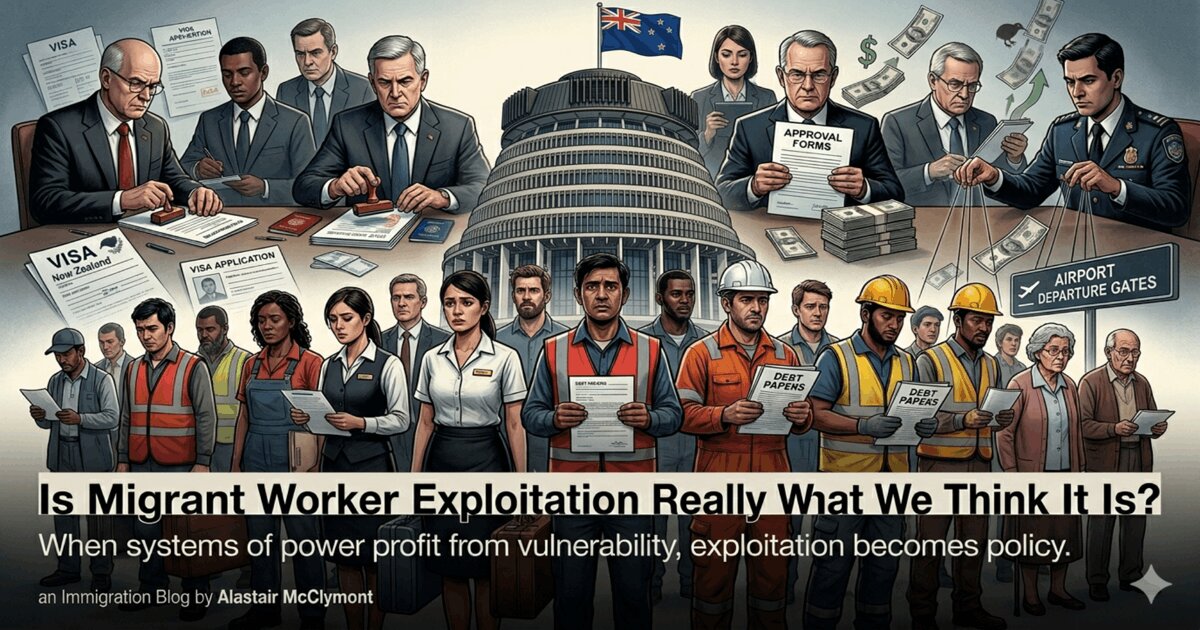
We hear a lot about migrant worker exploitation in New Zealand. Governments promise crackdowns. Ministers announce tougher penalties. Employers are named and shamed. The story we’re usually told is simple: a bad employer takes advantage of a vulnerable worker, and the solution is to punish the employer harder.
But I think that story is far too small — and, frankly, convenient.
To really understand what’s going on, we need to take a step back and ask a more uncomfortable question: what do we actually mean by exploitation?
Exploitation isn’t just a bad boss
In everyday discussion, exploitation has come to mean one person mistreating another. A rogue employer. An underpaid worker. An individual wrong.
But exploitation doesn’t have to look like that. At its core, exploitation is about vulnerability and unfair advantage. One party is exposed, desperate, or constrained. Another benefits from that vulnerability.
And nothing in that definition requires the exploiter to be an individual — or even to have bad intentions.
Which is where immigration systems come in.
When vulnerability is built into the system
Consider this: we’ve created an immigration framework where employers can obtain large numbers of job approvals, those approvals are effectively sold on open markets overseas, and migrants arrive in New Zealand having paid enormous sums for the chance to work — sometimes without a real job waiting for them at all.
The migrants take on debt. Families sell land or borrow money. People uproot their lives based on promises that look official because they are backed, indirectly, by the New Zealand government.
If that isn’t vulnerability being leveraged for someone else’s benefit, what is?
The state doesn’t need to demand money to be complicit
It’s tempting to say the government isn’t responsible because it’s not the one demanding payment for job offers or study pathways.
But exploitation doesn’t require direct involvement. It can happen through regulatory design.
When vague promises about “pathways to residence” or job approvals come stamped with government authority, they carry enormous weight. They look credible. They feel safe. They lower people’s scepticism.
That credibility is what allows private actors — employers, agents, intermediaries — to monetise hope.
And the government benefits too.
Why this system persists
Let’s be honest about why this continues.
International students have been quietly propping up New Zealand’s underfunded tertiary sector for decades. Migrant spending boosts local economies. Employers gain access to a cheap, compliant labour force that can’t easily walk away.
Even the money paid offshore for job offers doesn’t vanish. It circulates back into the system one way or another.
From a purely economic perspective, the arrangement works — just not for the people at the bottom.
“But they chose to come here”
There’s a predictable response to all of this: migrants choose to enter these arrangements. No one forces them. Free market, personal responsibility, end of story.
But that argument collapses the moment you apply it consistently.
We don’t allow businesses to deceive consumers just because someone “chose” to buy something. We don’t allow employers to lie in contracts even if workers sign them. We don’t shrug when vulnerable people are scammed and say they should have known better.
We recognise that vulnerability matters, and that deception and power imbalance change the moral equation.
So why do we suspend those principles when the victims are migrants?
Blaming the wrong people
What really concerns me is how relentlessly governments focus on individual employers as the sole site of exploitation.
Yes, some employers behave badly. But by framing exploitation as a series of isolated incidents, the state avoids confronting the uncomfortable truth: the system itself is doing the exploiting.
By design, it creates desperation.
By design, it monetises hope.
By design, it shifts risk onto people least able to absorb it.
And then, when things go wrong, it punishes the victims for being naïve, dishonest, or unlucky.
The story we don’t tell
If we were serious about migrant worker exploitation, we would be asking different questions.
Why do we allow immigration pathways that exist mainly as marketing tools?
Why do we tolerate a job approval system that can be commodified offshore?
Why do we accept an economy that depends on a workforce kept permanently insecure?
Instead, we tighten penalties, issue press releases, and reassure ourselves that the problem is under control.
It isn’t.
Exploitation isn’t just happening within the immigration system. It’s happening because of it.
And until we’re prepared to face that, all the enforcement in the world will just keep treating the symptoms — while the cause remains untouched.