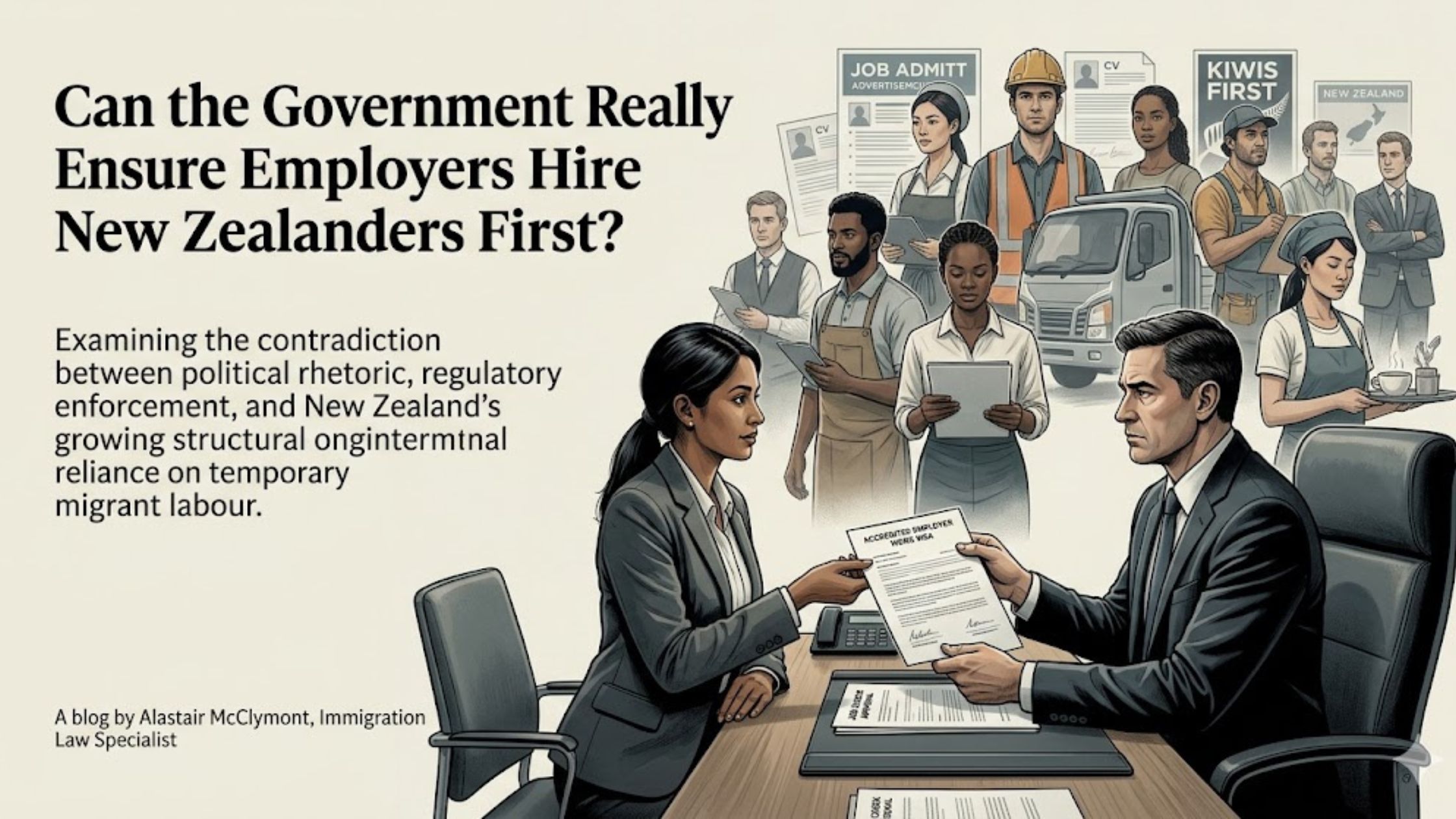
Examining the contradiction between political rhetoric, regulatory enforcement, and New Zealand’s growing structural reliance on temporary migrant labour.
In late 2025, Immigration Minister Erica Stanford publicly warned that employers could lose accreditation if they failed to make genuine efforts to recruit unemployed New Zealanders before turning to migrant labour. The message was politically effective and intuitively appealing.
Most New Zealanders would support the principle that local workers should be prioritised wherever possible. The Minister also correctly noted that thousands of temporary migrant workers who entered New Zealand following the COVID reopening will soon face visa expiry, while domestic unemployment has risen significantly since the Accredited Employer Work Visa framework was introduced in 2022.
Yet beneath this politically attractive rhetoric lies a much more difficult question: can the current immigration system meaningfully determine whether employers have genuinely attempted to recruit New Zealanders in good faith before turning to migrant labour?
The difficulty is that the framework underpinning the Accredited Employer Work Visa system may be structurally incapable of reliably answering that question.
This is not necessarily because employers are acting unlawfully or fraudulently. Rather, the problem is that the system itself relies heavily on forms of evidence that Immigration New Zealand often has limited practical ability to independently verify.
Anyone who has worked closely within the employer-assisted migration system understands how easily recruitment outcomes can be shaped long before Immigration New Zealand ever reviews a Job Check application.
Several years ago, I observed an informal recruitment exercise conducted on behalf of a hospitality employer seeking staff. An advertisement was placed on a mainstream employment website requesting CVs be sent to a generic Gmail address. After the initial advertising period concluded, the same advertisement was reposted with only one alteration: applicants were now instructed to send applications to “Mr Patel” at the identical email address.
The change in applicant response was dramatic. The number of New Zealand applicants fell substantially despite the role itself remaining unchanged.
The significance of this example is not racial or cultural. Rather, it demonstrates how applicant behaviour can be influenced by relatively subtle signals regarding employer identity and workplace expectations. More importantly, it illustrates how recruitment outcomes can be shaped in ways that are extremely difficult for regulators to detect or evaluate.
Similar dynamics appear elsewhere within the system.
Employers may advertise roles, receive applications from New Zealanders, then send follow-up communications requiring applicants to reconfirm interest, provide additional documentation, attend interviews at short notice, or satisfy pre-employment conditions. If applicants fail to respond or disengage from the process, this may later be presented as evidence that suitable New Zealand workers were unavailable or uninterested.
The problem for Immigration New Zealand is not simply whether such claims are true or false. The deeper issue is that the structure of the Privacy Act 2020 frequently limits Immigration New Zealand’s ability to independently verify the employer’s account with the applicants themselves unless consent has been obtained.
As a result, the system often depends heavily upon documentary evidence generated and supplied by the employer, while the regulator may have limited ability to test the underlying accuracy of the recruitment narrative being presented.
This creates a significant tension within the public discourse surrounding labour market protection.
Politically, the system is often presented as one in which migrant recruitment occurs only after rigorous efforts to recruit New Zealanders have failed. Operationally, however, the reality may be considerably more complex and difficult to verify.
This tension becomes even more significant when viewed alongside the broader structure of sectors within the New Zealand economy that have become deeply reliant on temporary migrant labour.
Anyone working closely with migrant employers and migrant workers can observe the emergence of what might loosely be described as parallel migrant economic networks: migrant-owned businesses employing migrant workers, often servicing migrant consumer communities, while operating within broader transnational commercial and social relationships.
These businesses may import products from overseas markets, provide culturally specific services, or rely heavily upon linguistic and community-based trust networks. In many such sectors, migrant labour is not peripheral to the business model but structurally embedded within it.
Yet public policy discourse often continues to frame migrant recruitment primarily as an exceptional response to domestic labour shortages rather than acknowledging the extent to which some sectors may now operate through enduring migration-dependent economic structures.
This raises difficult questions which are rarely openly discussed.
If parts of the economy have become structurally dependent upon temporary migrant labour, can the system genuinely function as policymakers publicly describe it? Or has the framework increasingly become a symbolic mechanism intended to reassure the public that New Zealand workers are being prioritised, even where meaningful verification of that priority may be extremely difficult in practice?
Equally, if these migration-dependent sectors are now economically embedded, what conversation should New Zealand be having about their long-term role and value within the wider economy?
These are not arguments either for or against migration. Nor are they criticisms of migrant employers or migrant workers themselves, many of whom are operating rationally within the incentives and constraints created by the system.
Rather, they point toward a deeper contradiction within contemporary immigration policy discourse: the gap between the political rhetoric of labour market protection and the practical realities of administering a migration system deeply intertwined with modern economic structures.
That contradiction deserves a far more open and honest discussion than it currently receives.