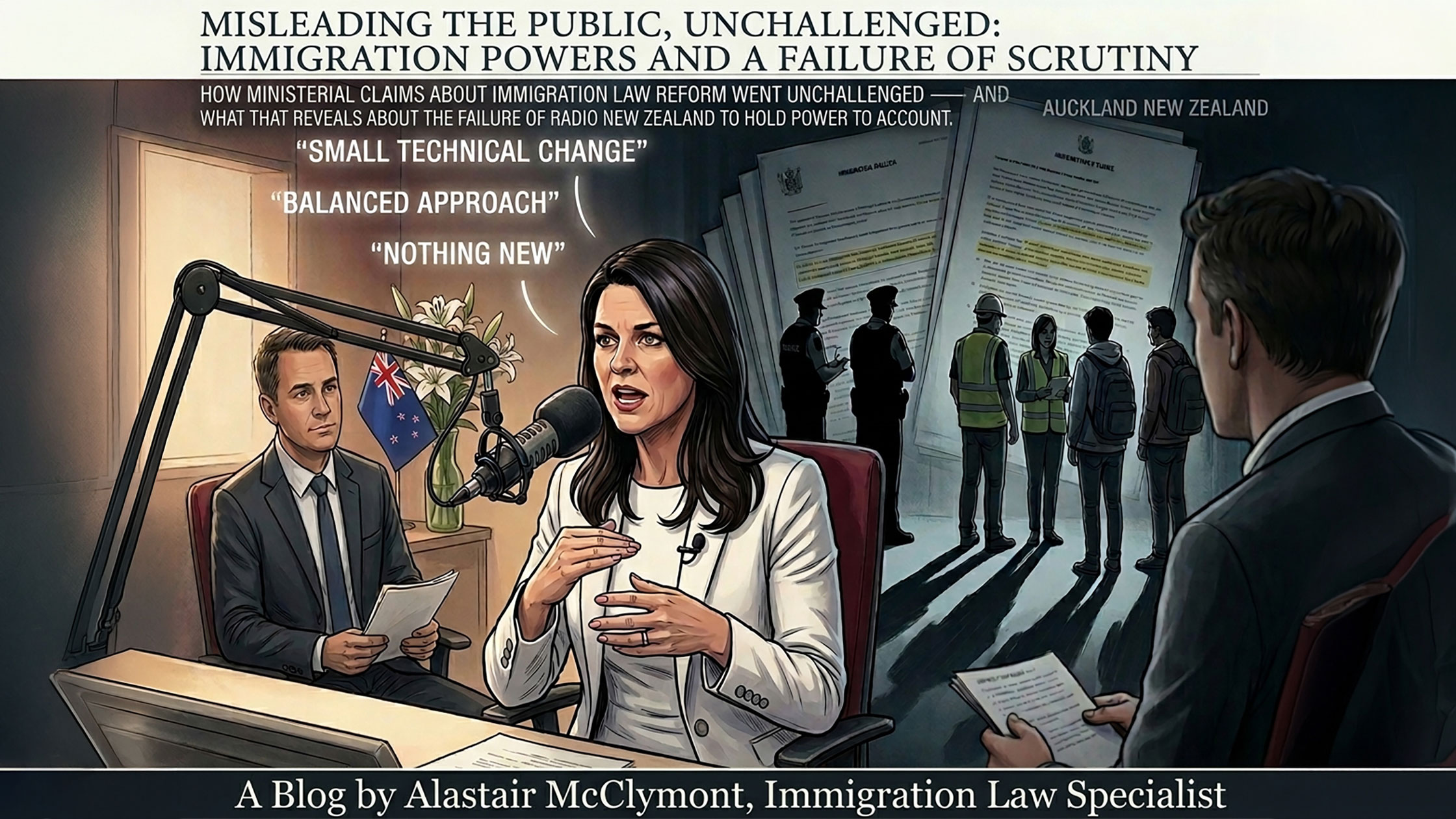
How ministerial claims about immigration law reform went unchallenged – and what that reveals about the failure of Radio New Zealand to hold power to account.
On Thursday 30 April, an interview on Radio New Zealand offered more than a discussion of immigration policy. It exposed a deeper problem: how ministerial claims about legislative change can go untested – leaving the public with a partial and misleading understanding of what the law actually does.
In that interview, Immigration Minister Erica Stanford described proposed amendments to section 280 of the Immigration Act 2009 as a “very, very small technical change.” She suggested that the power already exists and that the amendment simply lowers the threshold from requiring suspicion that a person is liable for deportation to one where they may be liable.
That characterisation is not simply an oversimplification. It omits the central feature of the amendment: the expansion of coercive powers into the lives of people lawfully present in New Zealand.
As is clear from section 280 of the Immigration Act 2009 and the proposed changes in section 26 of the Immigration (Enhanced Risk Management) Amendment Bill, the amendment does not merely insert two additional words. It expands the framework under which immigration officers may require individuals to provide identifying information – backed by the threat of arrest and detention for non-compliance.
Crucially, those expanded powers are not confined to individuals suspected of being unlawfully in New Zealand.
They extend to individuals who are lawfully in New Zealand but who may be in breach of visa conditions.
This includes scenarios such as:
- a student working beyond permitted hours
- a worker operating outside a specified region
- a visa holder performing duties inconsistent with their visa classification
In each of these cases, immigration officers may require identifying information, including nationality and country of birth. Refusal to comply may result in arrest and detention.
The existing section 280 power is already coercive. What the amendment does is expand who can be subjected to it.
That is not a technical adjustment. It is a substantive expansion of enforcement authority.
What Was Said vs What the Law Does
| What the Minister said |
What the legislation provides |
| “A very, very small technical change” |
A restructuring and expansion of section 280, broadening when powers can be exercised |
| The power already exists |
The scope of that power is extended to new categories of conduct |
| Change from “is liable” to “may be liable” |
Extension to potential breaches of visa conditions, not just deportation liability |
| Focus on overstayers |
Applies to people lawfully in New Zealand who may be non-compliant |
The problem is not that the Minister used simplified language. The problem is that the simplification removed the very element of the amendment that has generated concern among immigration professionals, civil liberties advocates, and migrant communities.
A description that focuses solely on a change from “is liable” to “may be liable” is not a neutral summary of the law. It is a selective account that leaves out the expansion of power to situations involving lawful visa holders.
At best, this is a failure to properly explain the legislation. At worst, it is a deliberate framing designed to minimise its impact.
The Overstayer Deflection
Throughout the interview, the Minister grounded her justification in addressing overstayers.
This is politically effective. It is also incomplete.
The legislative change is not confined to unlawful presence. It extends into the regulation of lawful visa holders and their compliance with conditions. By focusing exclusively on overstayers, the Minister avoided engaging with the broader – and more controversial – reach of the provision.
A Failure of Scrutiny
The failure of Radio New Zealand in this interview is not incidental. It is structural.
The interviewer identified concerns about speculative enforcement. He referenced the risk of “fishing” for individuals. But when presented with a characterisation of the law that did not reflect its operative effect, there was no follow-up.
No reference to the wording of the amendment.
No clarification of its application to lawful visa holders.
No challenge to the Minister’s framing.
This is precisely the moment at which the Fourth Estate is supposed to function – not as a conduit for political messaging, but as a check on it.
When that function is not performed, misleading claims are not corrected. They are amplified.
A Pattern, Not an Isolated Moment
This is not an isolated instance. The same framing has appeared in earlier public commentary, where concerns about expanded enforcement powers were met with repeated references to overstayers rather than engagement with the broader application of the law.
The effect is cumulative: a consistent narrowing of the public narrative, in which the most controversial aspects of the legislation are not directly addressed.
Whether by design or by default, this pattern has the same result – the public is left without a clear understanding of the true scope of the powers being introduced.
Two Possible Explanations
There are only two plausible explanations for the Minister’s description of the amendment.
The first is that she does not fully understand the scope of the legislative changes within her own portfolio. That in itself would be concerning.
The second is that she does understand the scope – and chose to present a partial account that downplays its significance.
If so, the public was not merely under-informed. It was misled.
Neither explanation reflects well. Neither is acceptable in a functioning democracy.
Why This Matters
This is not simply a dispute about legislative interpretation.
It is about whether the public can rely on Ministers – and the media – to provide an accurate account of laws that expand state power.
The amendment to section 280 materially broadens the reach of coercive enforcement powers. That is a legitimate subject of public debate.
But that debate can only occur if the public is told what the law actually does.
On 30 April, that did not happen.
And when mischaracterisation goes unchallenged, it does more than obscure a single piece of legislation. It erodes the mechanisms by which democratic accountability is meant to operate.
Alastair McClymont is an Auckland-based immigration lawyer with 29 years’ experience, with a particular focus on compliance, enforcement, and migrant rights.