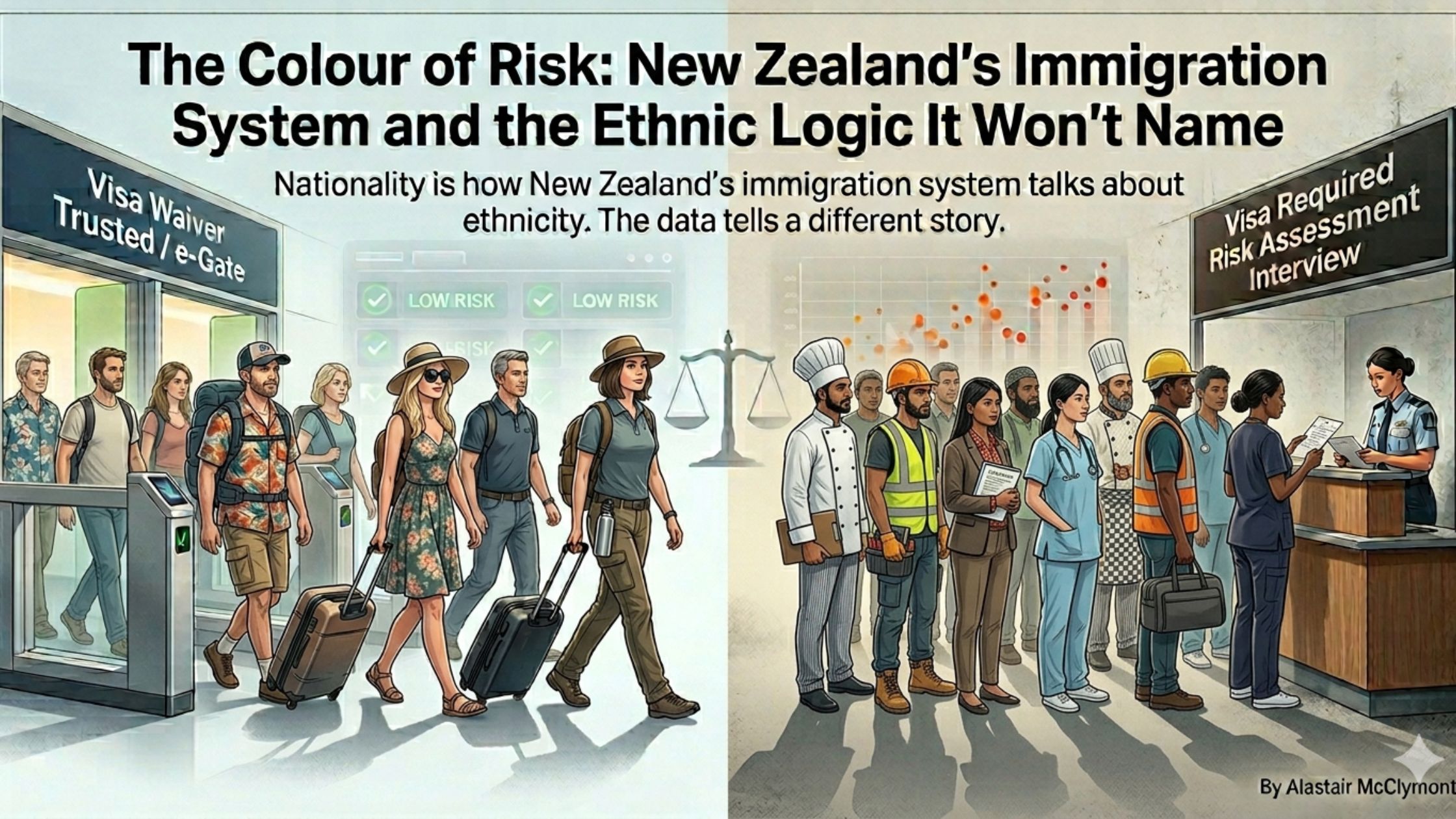
Nationality is how New Zealand’s immigration system talks about ethnicity. The data tells a different story.
A familiar pattern plays out on migrant Facebook groups when people ask why they, or their family members, were declined visas to New Zealand. Most replies focus on policy clauses and technical requirements — often from immigration advisers and lawyers. But a more direct answer is usually available: the real reason is typically the applicant’s country of origin.
That observation tends to provoke two reactions: some treat it as an accusation of racism, while others push back in defense of it, pointing out that describing how a system works is not the same as justifying it.
New Zealand’s immigration system formally assesses visa applicants on a range of individual factors: financial means, employment history, family ties, travel history, and prior undocumented status. But sitting beneath all of those criteria is a prior judgment that shapes how each application is weighted — nationality as a proxy for risk.
Applicants from certain countries are treated as inherently higher risk because they are said to be more likely to become undocumented migrants or breach visa conditions. This isn’t hidden. It’s built into the visa waiver system, which grants nationals of selected countries — predominantly Western liberal democracies — the right to enter New Zealand without a visa. Everyone else must apply, and in doing so, must prove they are a “bona fide” entrant.
The logic appears neutral. Countries are assessed on compliance history, diplomatic relationships, and immigration risk. No one is singled out by ethnicity. And yet the countries that receive visa waivers are, with very few exceptions, majority-white Western nations. The countries whose nationals must prove their intentions — and who face the highest decline rates — are predominantly in Asia, the Pacific, and the Global South.
The data, however, tells a more complicated story. Immigration New Zealand’s own figures show that among the top ten nationalities represented in undocumented migrant numbers, visa waiver countries account for the largest share — around 36%. Pacific Island nations account for around 29%, and Asian countries around 34%. Visa waiver countries from the Western world alone make up roughly 30% of undocumented migrants — more than Pacific Islanders and only slightly fewer than Asians.
Becoming undocumented, in other words, is not confined to the “untrusted” nationalities.
The two nationalities most often cited in public and political discourse as immigration risks — undocumented Pacific Island families and undocumented Asian workers — are real parts of the picture. Yet together, those two nationalities accounted for only about 28% of undocumented migrants from the top ten nationalities.
So if the data doesn’t straightforwardly support the idea that visa-required nationalities dominate undocumented migrant numbers, why do enforcement and deportation patterns look so different? An answer emerges from an Immigration New Zealand briefing to an incoming Minister in 2017, obtained under the Official Information Act. It stated that compliance action — including deportation — was focused on “those most vulnerable to exploitation.” That framing raises an uncomfortable question: why does vulnerability to exploitation become a basis for removal rather than protection?
The answer lies in how the system identifies cases. Undocumented migrants from visa waiver countries are more likely to be self-sufficient, socially connected, and able to remain invisible to enforcement agencies. Undocumented migrants from visa-required countries are more likely to be working in exploitative conditions — in horticulture, hospitality, or domestic labour — where their immigration status is known to their employer and where labour inspectors or police are more likely to encounter them.
That creates a perverse outcome. Those most vulnerable to exploitation are also the most likely to face detention and deportation when the system finally intervenes. Migrants from “trusted” countries, by contrast, remain prominent among undocumented migrants but largely absent from enforcement action — and from public and political narratives around immigration risk.
A system that cannot say the word ethnicity but reliably produces ethnic outcomes isn’t neutral. It’s just careful with its language. And there is a meaningful difference between a system that is unaware of what it does, and one that has simply learned not to say it out loud.