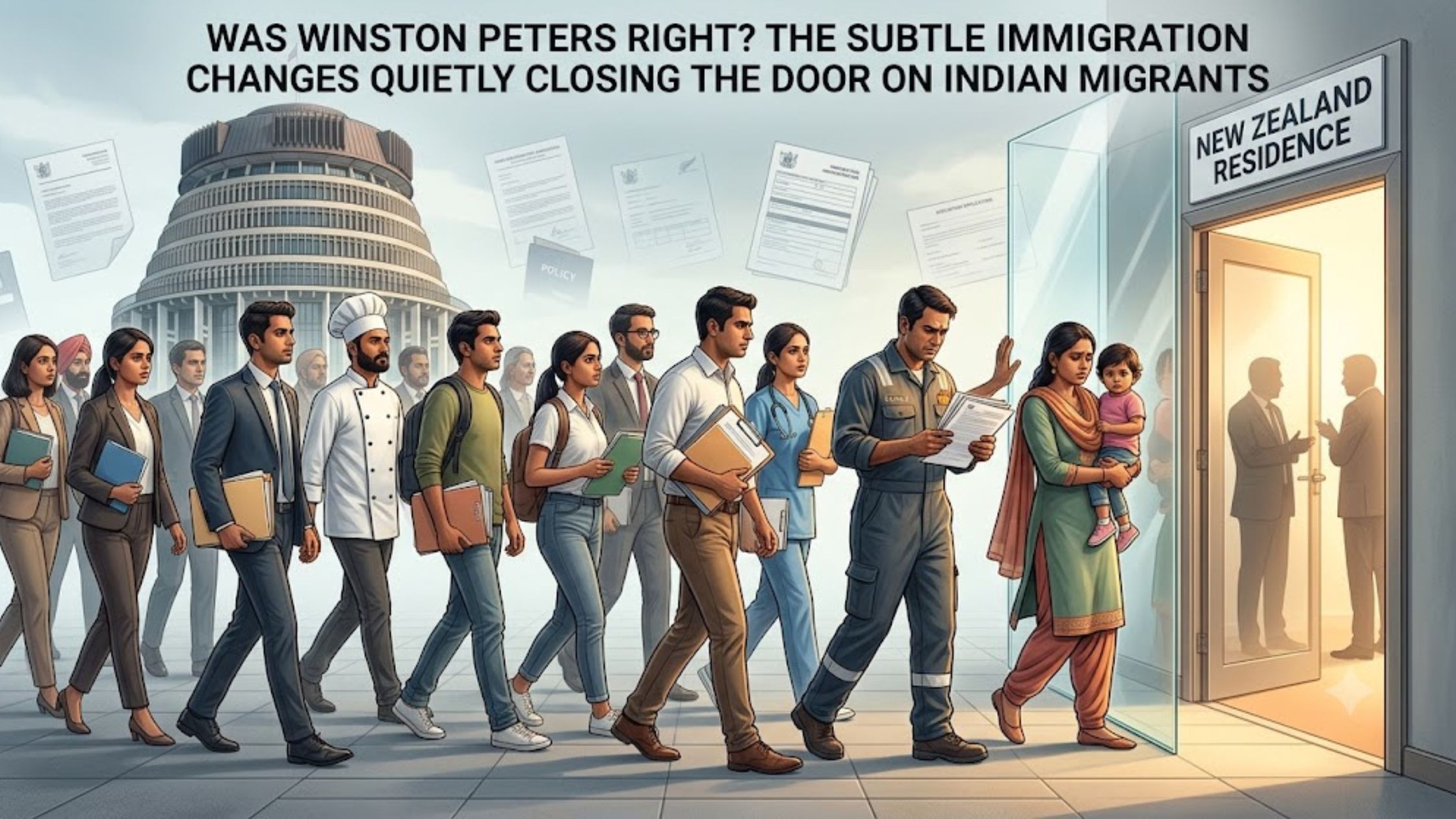
Winston Peters recently claimed that Immigration Minister Erica Stanford had quietly changed New Zealand’s immigration settings in a way that would make it harder for Indian migrants to obtain residence. He also alleged in Parliament that immigration officials had advised the Minister not to publicly announce those changes because of the likely reaction from India and the potential implications for New Zealand’s trade relationship.
These are serious allegations, and they deserve careful examination.
At first glance, they appear overstated. The immigration instructions introduced on 18 June 2026 do not mention India, nor do they create different legal requirements for Indian nationals.
But that is only part of the story.
In practical terms, Winston Peters has identified something far more significant. While the immigration instructions never refer to India, some of the new evidential requirements are likely to have a disproportionate impact on Indian applicants seeking residence. The effect is subtle, but potentially profound.
This blog examines one of those policy changes and explains why its practical consequences may fall far more heavily on Indian migrants than on most other nationalities.
The policy changes Mr Peters is referring to are almost certainly the amendments to the Immigration New Zealand Operational Manual issued on 18 June 2026. Those amendments do not target India by name. They will also affect applicants from other countries. However, because of the sheer number of Indian nationals currently in New Zealand on temporary visas who hope to transition to residence, they are likely to be affected more than any other nationality.
Approximately 50,000 Indian nationals currently hold work visas, while a further 20,000 hold student visas. In my reading of the immigration instructions, the recent changes have made it significantly more difficult for many of these visa holders to qualify for residence under the Skilled Migrant pathways.
Before examining one particular amendment, it is worth noting another trend that has emerged since these policy changes were announced. Many immigration advisers and lawyers who market primarily to Indian migrants have presented these changes as creating new opportunities for residence.
In my opinion, that is highly misleading.
Much of the marketing material I have seen significantly overstates the opportunities now available to Indian applicants while paying little attention to the additional evidential hurdles that many will face.
As I have argued consistently in these blogs, and in my comments to mainstream media, both National and Labour-led governments have, over the past five years, steadily moved towards an immigration system in which most migrants from India—other than highly skilled professionals such as registered health practitioners and IT specialists—are increasingly viewed as desirable primarily as temporary migrants.
Students help subsidise New Zealand’s tertiary education sector, while temporary workers fill labour shortages in industries that struggle to recruit locally. But when those same migrants seek residence, the barriers become considerably higher.
One of the ways this is now being achieved is through the definition of “genuine employment”, particularly in relation to the evidence required to prove overseas work experience.
The significance of these amendments is that the verification requirements for overseas work experience are considerably more demanding for residence applications than they are for temporary work visas. This gives Immigration New Zealand greater discretion over whether evidence of previous overseas employment will be accepted.
When labour shortages exist, that discretion can be exercised relatively lightly, enabling large numbers of temporary workers to enter New Zealand. When political priorities change and migration numbers need to be reduced, the same evidential requirements can become a significant barrier to residence.
We have seen this before.
Following the COVID-19 pandemic, New Zealand urgently needed workers to support economic recovery. Verification of overseas work experience, particularly from India, was often minimal. This created opportunities for both New Zealand and Indian-based immigration agents to submit false employment documentation, frequently without the applicant’s knowledge, while charging substantial “success fees” once visas were approved.
Immigration New Zealand is now devoting considerable resources to investigating those same applications and deporting workers whose visas were granted during that period.
The political narrative has shifted from facilitating entry to demonstrating that action is being taken against migrants whose applications are now considered problematic.
Against the backdrop of an election year, public concern about migration, and negotiations surrounding the India Free Trade Agreement, it is unsurprising that the Government would seek to reduce future residence numbers without explicitly identifying any particular nationality.
Changes to immigration instructions provide one means of achieving that objective.
For many residence applicants, overseas work experience is essential.
Under the Skilled Migrant Category, applicants may rely upon overseas skilled employment to satisfy work experience requirements. However, that employment must now be demonstrated through documentation including employment or service agreements detailing the employee’s occupation, hours of work and remuneration, together with tax records or official income statements confirming both the period of employment and earnings.
These are forms of documentation that are commonplace in countries such as New Zealand, but not necessarily in India, where employment relationships are frequently less formalised and where income tax obligations differ significantly. Many occupations likely to be pursued in New Zealand—including chefs and a range of skilled trades—may not generate the type of documentary evidence now required.
The practical consequence is that many genuine periods of skilled employment in India may no longer be recognised for residence purposes.
The immigration instructions never mention India. They don’t need to. Their practical effect is to make residence significantly more difficult for many Indian migrants while leaving temporary migration pathways largely intact.
In that sense, Winston Peters’ broader observation deserves serious consideration.
While many advisers and lawyers continue to promote residence pathways to the Indian market, much less attention is being given to the new evidential barriers that now confront applicants.
The result is an immigration system that continues to encourage Indian students and workers to come to New Zealand on temporary visas while quietly making the transition to residence increasingly difficult.
That should concern not only Indian migrants, but anyone who believes New Zealand’s immigration system should be transparent, predictable and honest about the opportunities it offers.