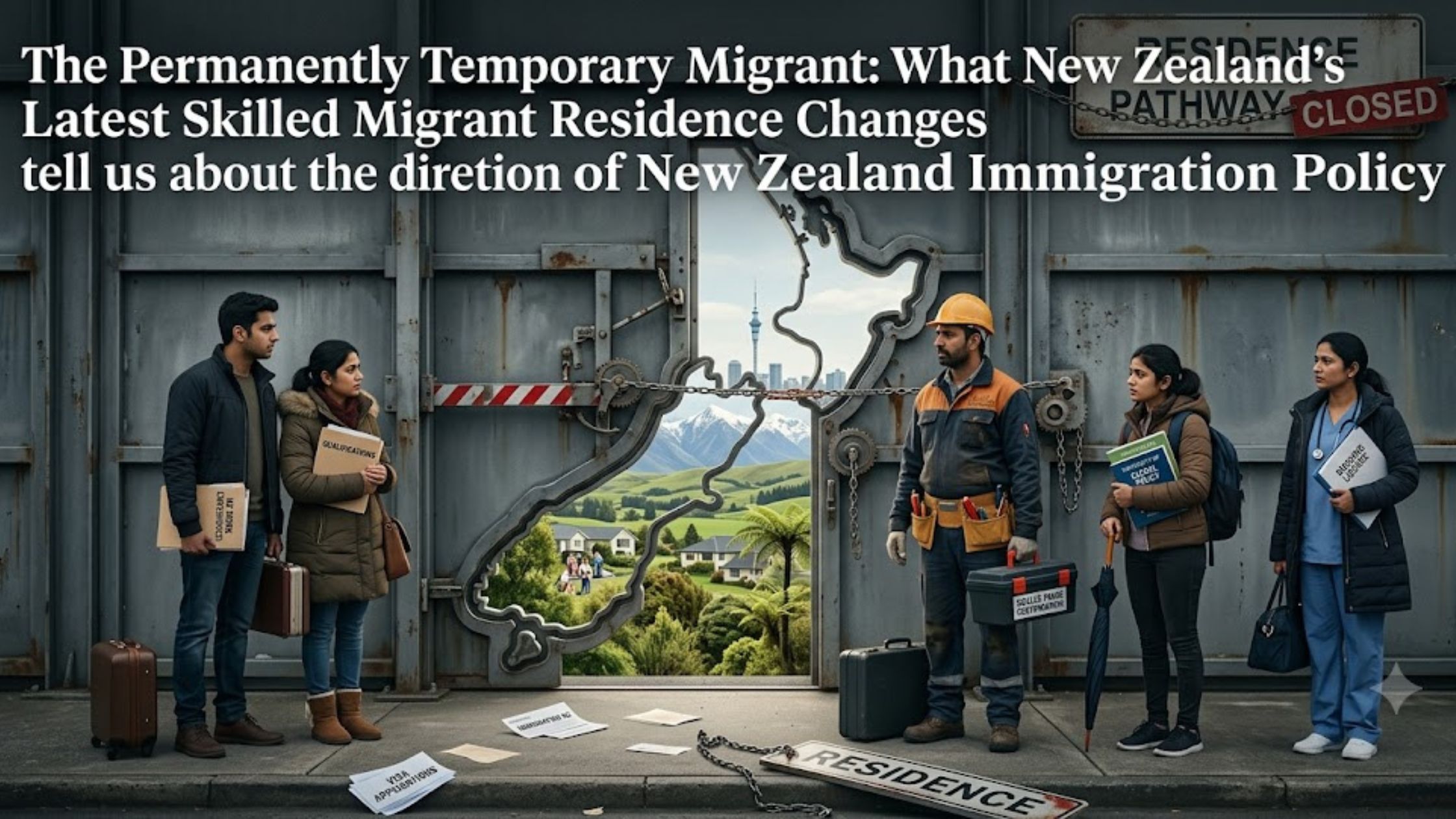
In August this year, New Zealand will introduce significant changes to its skilled residence programme, including two new residence pathways: the Skilled Work Experience Pathway and the Trades and Technicians Pathway. The reforms have generally been welcomed within the immigration industry as long-overdue improvements.
However, the real significance of these changes lies not in the individual policy amendments themselves, but in what they reveal about the continuing evolution of New Zealand’s immigration system.
In 2024, New Zealand sociologist Professor Francis Collins used the term “permanently temporary migrant” to describe migrants who spend years living and working in New Zealand while remaining in a prolonged state of legal temporariness. The concept provides a particularly useful framework for understanding the evolution of New Zealand’s skilled migration policies over the past three decades.
Viewed through that lens, the latest residence reforms are not simply technical amendments to immigration instructions. Rather, they represent the latest stage in the continuing evolution of an immigration system that has become increasingly reliant upon temporary migrant labour while progressively narrowing opportunities for those same migrants to obtain permanent residence.
The permanently temporary migrant invests years of their life, substantial financial resources and often their family’s future into studying and working in New Zealand, believing that these investments provide a genuine pathway to permanent residence. Instead, successive policy reforms introduce new requirements, new barriers and increasing uncertainty, making permanent settlement progressively more difficult to achieve.
As I have argued in previous blog posts, this has become one of the defining characteristics of New Zealand’s immigration system over the past three decades.
Over that period, temporary visa numbers have grown dramatically while residence approvals have remained comparatively constrained. Governments of both major political parties have largely maintained this approach. Temporary migration has continued to expand while permanent settlement has become increasingly selective.
This presents New Zealand with a structural challenge.
Compared with Australia, North America and much of Europe, New Zealand offers relatively modest wages. Our geographic isolation also makes it expensive and difficult for migrants to maintain close family relationships while working here.
Consequently, New Zealand faces two competing objectives.
On one hand, employers benefit from access to a large workforce of temporary migrants whose ability to remain in New Zealand depends upon continuing employment. On the other hand, New Zealand must still attract migrants with the qualifications, work experience and English-language ability that employers require.
The practical response has been the gradual evolution of immigration policies that appear to provide clear pathways to residence while making those pathways increasingly difficult to satisfy.
On the surface, skilled residence policies appear generous. In practice, however, they contain multiple requirements that substantially reduce the number of applicants who ultimately qualify.
Prior to COVID-19, for example, many international students enrolled in business qualifications believing that obtaining employment as a retail or office manager would place them on a relatively straightforward pathway to residence because those occupations were classified as skilled.
Marketing by offshore education agents, together with countless discussions across social media, continues to reinforce the belief that obtaining a New Zealand qualification followed by skilled employment will normally lead to permanent residence.
The reality is considerably more complicated.
The latest policy changes are likely to make residence more difficult for many temporary migrants. Their practical effect is likely to fall particularly heavily upon migrants from South Asia, who comprise a significant proportion of New Zealand’s international student population and temporary skilled workforce.
The consequence is that universities continue to benefit from international education revenue while employers continue to benefit from access to temporary migrant labour, yet the pathways to permanent settlement become progressively narrower.
At the same time, Immigration New Zealand continues to strengthen its ability to identify, locate and remove migrants who remain in New Zealand after their temporary visas expire.
Historically, New Zealand’s immigration system recognised that some migrants eventually develop deep social, economic and community ties that justify permanent residence. This is what political theorists often describe as the acquisition of social membership.
The current reforms make that transition increasingly difficult.
This becomes particularly significant following the implementation of the New Zealand–India Free Trade Agreement.
By tightening residence pathways while maintaining substantial numbers of temporary visas, the practical consequence is that increasing numbers of Indian nationals may enter New Zealand on temporary visas while comparatively fewer ultimately qualify for residence. Whether intentional or not, this distinction is likely to become an increasingly important feature of New Zealand’s immigration statistics in the years ahead.
Several aspects of the new policy demonstrate this trend.
Trades workers seeking recognition of overseas work experience must now provide extensive documentary evidence, including taxation records and detailed employment agreements. While such documentation may be commonplace in some countries, many skilled tradespeople throughout Asia and other developing regions have worked in informal labour markets where these records simply do not exist.
Similarly, the introduction of the Red and Amber occupational lists creates additional barriers for occupations in which Indian migrants are disproportionately represented.
Many of those occupations are now subject to salary thresholds that exceed prevailing market wages.
At the same time, immigration officers are directed to consider whether unusually high salaries genuinely reflect market conditions. Applicants therefore face the paradox of needing salaries high enough to satisfy policy while simultaneously risking scrutiny because those salaries appear unusually high.
The result is an immigration framework that increases uncertainty while creating greater opportunities for wage manipulation, artificial salary arrangements and labour exploitation.
Ultimately, these reforms reinforce the model of the permanently temporary migrant.
Workers remain economically valuable while their labour is required, yet increasingly struggle to obtain permanent residence. After several years they can simply be replaced by new cohorts of temporary migrants prepared to invest once again in education and employment on the understanding that residence remains attainable.
An economy that becomes structurally dependent upon temporary migrant labour creates incentives for low productivity, wage suppression and labour exploitation. Employers become less reliant on investing in training, technology and improved working conditions because a continual supply of temporary workers is available. At the same time, migrants become increasingly vulnerable because their ability to remain in New Zealand depends upon employment while their opportunities to obtain permanent residence continue to diminish.
The consequences extend beyond economics.
When temporary migration is promoted as a pathway to settlement but increasingly fails to deliver permanent residence, frustration inevitably develops. Public debate then risks focusing upon migrant communities themselves rather than upon the policy settings that created those expectations in the first place. Indian migrants, because they comprise one of the largest groups affected by these changes, may disproportionately bear the social and political consequences of that frustration.
If New Zealand wishes to operate a genuinely temporary migration programme, it should say so openly and honestly. Migrants should understand from the outset that they are being invited to meet temporary labour shortages rather than encouraged to believe that years of study, work and financial investment will probably lead to permanent residence.
If, however, New Zealand wishes to continue promoting education and skilled employment as pathways to settlement, then those pathways should be genuine, transparent and realistically attainable. Immigration policy should not create expectations that it has little realistic prospect of fulfilling.