If you want to see where an immigration system can end up when cruelty becomes normal, you don’t have to look very far right now. Just look at the United States.
There, immigration enforcement has become openly violent and performative: armed raids, family separations, detention camps, political rhetoric that treats migrants as criminals by default, and a public discourse that frames entire communities as threats. Much of it is defended as “just enforcing the law.” Much of it is bureaucratic. Much of it is done by people who insist they are simply following procedure.
That matters, because those extremes don’t appear suddenly. They grow out of systems that gradually normalises fear, vulnerability, and dehumanisation, long before the batons and razor wire arrive.
And that’s why New Zealand needs to look very hard at its own immigration system — not because we are the United States, but because we are walking further along the same continuum than we like to admit.
I’ve spent a long time thinking about New Zealand’s immigration system, and the uncomfortable conclusion I’ve reached is this: we’ve created a system that relies on exploitation, normalises it, and then pretends not to notice the human cost.
This didn’t happen overnight, and it didn’t happen because of a few bad employers or a handful of ugly political comments. It happened because immigration policy slowly stopped being about people and quietly became about feeding a particular economic model.
From settlement to “permanently temporary”
Once upon a time, immigration policy was broadly about population growth and settlement. People came here, put down roots, and became part of the country. That’s no longer the core objective.
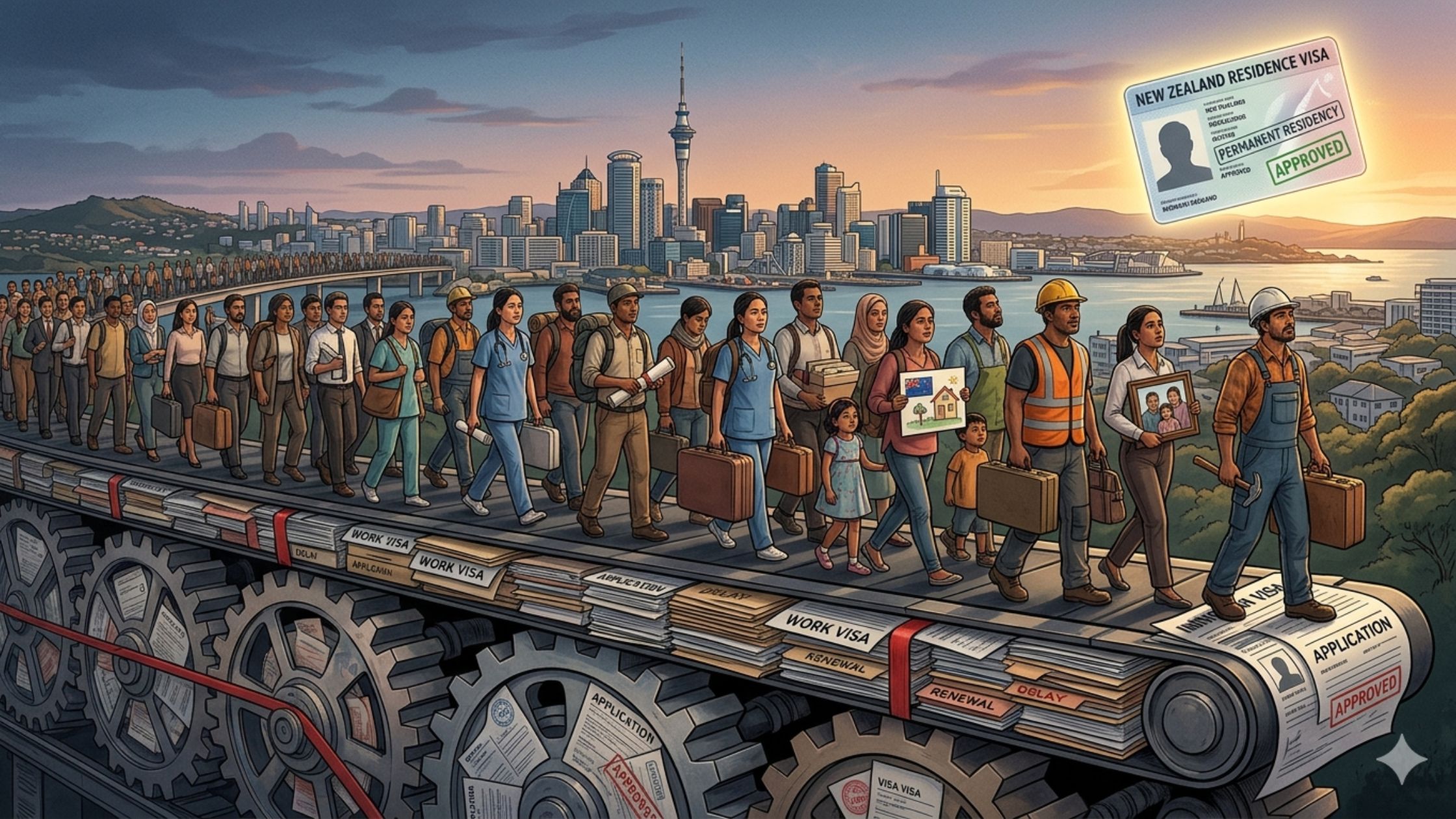
What we have now is a growing class of people I refer to as permanently temporary migrants. These are people who arrive in New Zealand with the clear intention of settling here, but who are kept on temporary visas for years — sometimes decades — with no real guarantee of ever becoming residents.
The system dangles residency like a prize just out of reach. There’s always another requirement, another rule change, another reason the goalposts have moved. The promise of permanence becomes a mirage: visible enough to keep people chasing it, but rarely attainable.
A system built on vulnerability
This is where exploitation creeps in — not accidentally, but structurally.
Students pour their life savings into New Zealand qualifications that often have little value outside the country. Workers accept unsafe conditions, unpaid hours, or outright illegal arrangements because their visa is tied to their employer. Some pay employers for jobs. Others quietly return part of their wages just to stay employed.
And the state isn’t a neutral bystander here. Immigration policy is deliberately vague, discretionary, and unpredictable. That uncertainty keeps people compliant. It ensures a steady supply of cheap, controllable labour for industries that depend on it.
Fear is the lubricant that makes the system run.
What this does to people
Living on a temporary visa isn’t just administratively inconvenient — it reshapes your entire life.
You hesitate to complain at work.
You avoid drawing attention to yourself.
You delay having children.
You live with the constant threat of detention or deportation for minor breaches.
Families are separated for years. Partners and children are treated as optional extras rather than human beings. In some cases, children born here grow up without security or belonging.
People are reduced to economic units, not neighbours, not community members. Disposable labour, easily replaced.
The quiet spread of racial harm
To justify treating this group differently, the system needs a story. And the story we tell — sometimes openly, sometimes through hints and dogwhistles — is that certain migrants are less trustworthy, less deserving, less valuable.
It’s no coincidence that suspicion and stigma tend to fall on people from India, China, and other visible migrant communities. Crime narratives, fraud panic, and moral judgement attach themselves not just to migrants, but to entire ethnic groups.
This harms everyone. Citizens who share the same skin colour or cultural background are forced to live with assumptions they didn’t earn. Work itself is devalued when entire sectors become “migrant jobs.” Employers learn to prefer tied workers over locals who can walk away.
Why this should worry all of us
The most dangerous thing about this system isn’t that it’s cruel — it’s that the cruelty is normalised.
When harm is built into bureaucracy, it stops looking like harm. It becomes procedure. When fear becomes routine, we stop noticing it. And once a society accepts the systematic mistreatment of one group, it becomes easier to justify mistreatment of others.
That’s how you end up where the United States is now: not overnight, but step by step, policy by policy, exception by exception.
This isn’t about tweaking policy
This problem can be fixed with a small regulatory adjustment or a new visa category.
The real issue is moral.
We’ve accepted the idea that immigration policy is morally neutral — that it’s just economics, just labour markets, just supply and demand. It isn’t. Every immigration system is a statement about who counts, who matters, and how far we’re willing to go to benefit from someone else’s vulnerability.
A society that claims to value fairness, dignity, and human rights cannot justify exploiting non-citizens simply because it’s profitable.
Where we go from here
Avoiding a darker future requires something uncomfortable: honest public debate. We need to stop pretending this system is accidental. We need to question the economic assumptions driving it. And we need to reject the idea that cruelty is an acceptable administrative tool.
If we don’t, the damage won’t stop with migrants.
It never does.