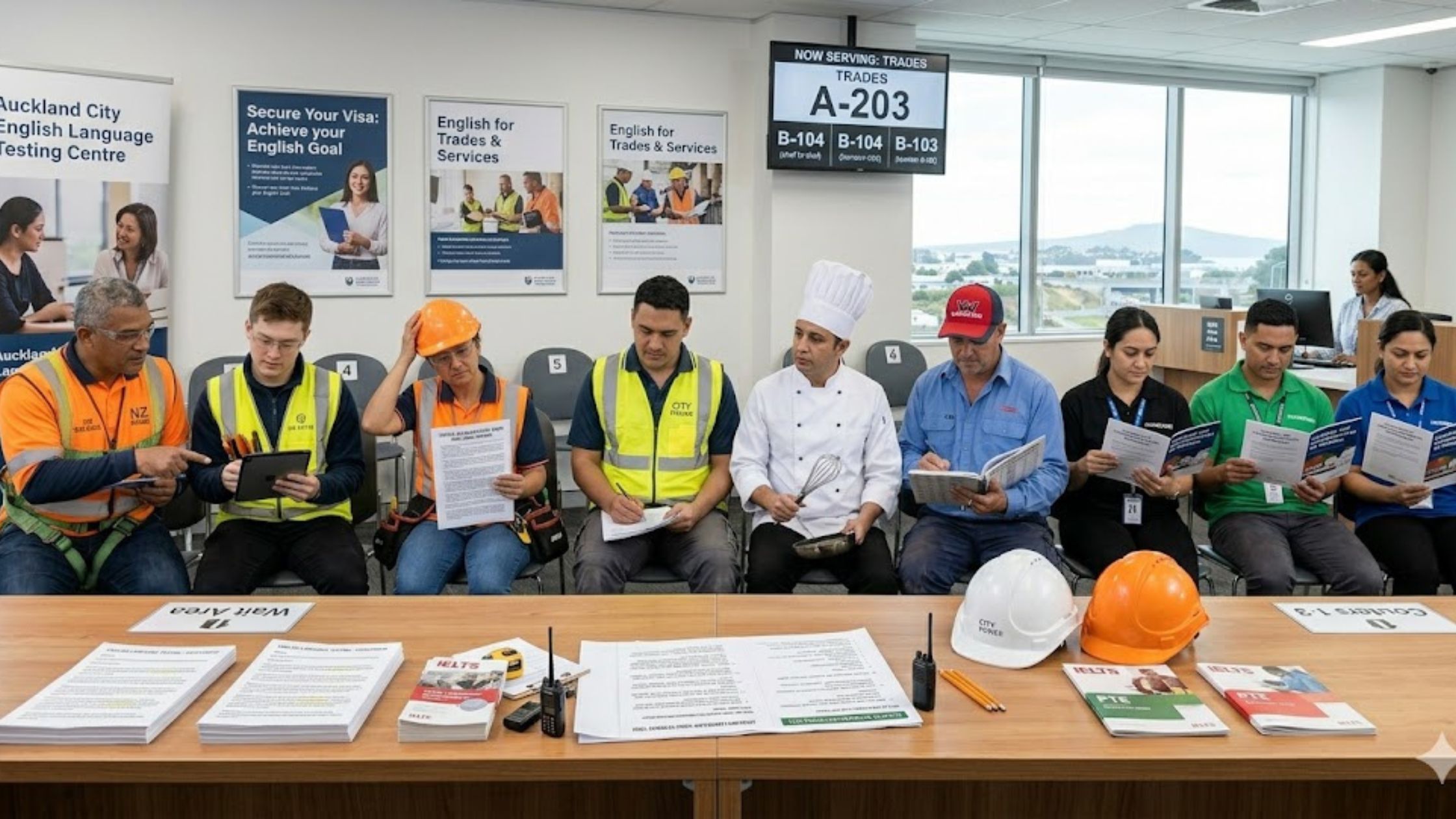
Extended to AEWV Skill Level 3 Roles: What Employers and Migrants Need to Know
From 1 June 2026, the minimum English language requirement that has applied to Accredited Employer Work Visa applicants in skill level 4 and 5 occupations now extends to skill level 3. This is a material change for a broad range of employers who have been recruiting into technical, trades, and supervisory roles from offshore. It is also a change that arrives with transitional arrangements that need to be understood precisely — because the exemptions are targeted, not general.
This note sets out what has changed, who is affected, how the transitional provisions work, and what employers and migrants should be doing now.
1. The Change in Brief
The Accredited Employer Work Visa (AEWV) minimum English language requirement previously applied only to applicants in ANZSCO or NOL skill level 4 and 5 occupations. Those applicants were required to demonstrate that they can speak and understand English, either through citizenship or education in an English-speaking country, work experience in an English-speaking environment, or by sitting a recognised English language test.
From 1 June 2026, that same requirement applies to applicants in ANZSCO or NOL skill level 3 occupations. Skill level 3 covers a significant portion of the trades and technical workforce — electricians, plumbers, construction trades and a range of other occupations that sit below the professional tier but well above the lower-skilled categories. For many accredited employers, this is exactly where their offshore recruitment has been concentrated.
Practical point: if you are an accredited employer with a job check token issued before 1 June 2026 for a skill level 3 role, that token does not exempt the applicant from the new English language requirement. Migrants applying from 1 June 2026 onwards must meet the new standard regardless of when the job check was completed.
2. How the Requirement Is Met
The English language requirement for an AEWV is not a single fixed test score. There are several pathways through which an applicant can satisfy it, and the right pathway depends on the individual’s background.
- citizenship of Canada, the Republic of Ireland, the United Kingdom or the United States of America, provided the applicant has spent at least five years in work or education in one or more of those countries or Australia or New Zealand; or
- a qualification comparable to a New Zealand level 7 bachelor’s degree and gained in Australia, Canada, New Zealand, the Republic of Ireland, the United Kingdom or the United States of America as a result of study undertaken for at least two academic years in one or more of those countries; or
- a qualification comparable to a New Zealand qualification at level 8 or above and gained in Australia, Canada, New Zealand, the Republic of Ireland, the United Kingdom or the United States of America as a result of study undertaken for at least one academic year in one or more of those countries.
- Where neither of the above applies, the applicant must sit a recognised English language test and achieve the minimum score. The accepted tests include IELTS, TOEFL iBT, PTE Academic, OET, and Cambridge C1 Advanced. The minimum standard is equivalent to an overall IELTS overall score of 4 or more.
Practical point: test results take time. IELTS and PTE Academic centres in many source countries have wait times of several weeks for available test dates, and results are typically released within two weeks of sitting. Employers should factor test preparation and sitting time into their offshore recruitment timelines for skill level 3 roles.
3. Transitional Arrangements: Who Is Exempt and Under What Conditions
The transitional arrangements are targeted rather than broad. They address two specific groups. Understanding exactly who falls within each group — and who does not — is critical.
Group one: Existing AEWV holders whose visa expires on or before 1 December 2026
A person who currently holds an AEWV and whose visa expires on or before 1 December 2026 will be exempt from the new English language requirement when applying for a further AEWV at skill level 3. The rationale is straightforward: these individuals have limited time on their current visa, and requiring them to sit and pass an English test before their visa expires may not be practically achievable given test availability and results timelines.
This exemption is time-limited. It applies only to the next AEWV application made by this group and only where the visa expiry falls on or before 1 December 2026. A person in this group who is granted a further AEWV and then seeks to renew again in 2027 will not be covered by this exemption and will need to meet the standard English language requirement at that point.
Group two: Applicants who have already provided English language evidence in a previous AEWV application
A person who has previously provided evidence of English language ability as part of an earlier AEWV application is also exempt from the new requirement. This reflects the principle that a person who has already demonstrated compliance should not be required to demonstrate it again.
Note: This exemption attaches to the individual, not the employer. If a person changes employer or role but has previously satisfied the English language requirement in an earlier AEWV application, they carry that compliance with them.
Who is not covered
The following applicants are not covered by the transitional arrangements and must meet the new English language requirement from 1 June 2026:
- Applicants making a first AEWV application at skill level 3 on or after 1 June 2026 who have not previously provided English language evidence in an AEWV application.
- Existing AEWV holders at skill level 3 whose visa expires after 1 December 2026, when they apply for a further AEWV.
- Applicants relying on a job check token issued before 1 June 2026. The token does not carry an English language exemption.
4. What Is Not Affected
Several categories are expressly excluded from the new requirement, and it is worth being precise about them.
- Global Workforce Seasonal Visa and Peak Seasonal Visa applications. These remain exempt from the minimum English language standard. The seasonal workforce pathway operates under a different policy rationale and is not affected by this change.
- Job change applications. An AEWV holder who is changing employer or role within the AEWV framework does not trigger the new English language requirement through the job change process alone.
- Existing AEWV holders during the life of their current visa. No one with a current AEWV is affected retrospectively. The change does not alter the conditions of a visa already granted.
Practical point: job change applications are not exempt indefinitely. The English language requirement will apply when the next AEWV application is made following the job change, unless the applicant falls within one of the transitional exemptions.
5. Implications for Accredited Employers
For accredited employers actively recruiting into skill level 3 roles, this change requires an adjustment to offshore recruitment processes. The practical adjustments are not complicated, but they need to be made now.
- Update job offer and pre-departure documentation. Offshore candidates for skill level 3 roles should be informed of the English language requirement at the point of job offer. The requirement, the accepted tests, and the minimum scores should be clearly set out in any pre-visa documentation provided to the candidate.
- Build test lead time into visa timelines. For candidates who need to sit a test, the window between job offer and intended start date needs to accommodate test availability, sitting time, and results. In some source countries, that window should be at least six to eight weeks.
- Audit your current workforce pipeline. If you have candidates in the pipeline for skill level 3 roles who have not yet applied for their AEWV, check whether they satisfy the English language requirement through the citizenship or prior study/work pathways before assuming a test will be required. Some will qualify without sitting a test.
- Review your job check strategy. Job check tokens issued before 1 June 2026 do not carry an English language exemption for the visa applicant. If you have tokens in hand and candidates who have not yet applied, they will need to meet the new English requirement when they lodge.
Practical point: accredited employer status does not create an exemption from the English language requirement, and it does not transfer liability to INZ if a visa application fails because the English evidence is missing or insufficient. The employer’s role is to ensure candidates are properly prepared before lodgement.
6. Implications for Migrants
For migrants currently on an AEWV at skill level 3, the immediate message is straightforward: your current visa is unaffected. You do not need to do anything now in relation to English language compliance on the basis of this change.
The question that matters is what happens when your current visa expires. At that point:
- If your visa expires on or before 1 December 2026, you are within the transitional exemption and will not need to meet the new English language requirement for your next AEWV application at skill level 3.
- If your visa expires after 1 December 2026, you will need to meet the English language requirement when you apply for your next AEWV, unless you have previously provided English language evidence in an earlier AEWV application.
- If you are planning to make your first AEWV application for a skill level 3 role from 1 June 2026, you must meet the new requirement regardless of any job check token your employer holds.
For migrants who need to sit a test, the standard to meet is an overall IELTS score of 4 or more. This is a general, everyday English standard. It is not a high bar, but it is a real bar, and preparation matters for applicants whose everyday working language is not English.
The Righteous Perspective
This change is not unexpected. The extension of English language requirements to skill level 3 is consistent with the policy direction that has been evident in the AEWV framework since its introduction: closer alignment between the immigration settings for different skill tiers, and greater emphasis on migrant integration and the ability to engage with workplace rights and obligations.
INZ has framed the rationale in terms of integration, rights awareness, and the ability of migrants to identify and report non-compliant employers. That framing matters. It suggests the English language requirement is being treated not merely as a competency filter but as a protection mechanism for migrants themselves. Employers who take that framing seriously will invest in ensuring their offshore recruits are properly prepared, not just nominally compliant.
The transitional arrangements are targeted and fair. They do not create a general grace period. They protect specific individuals who are mid-visa and for whom the change would otherwise create an immediate and disproportionate burden. Employers and migrants who fall outside those categories should treat 1 June 2026 as the operative date and plan accordingly.
At Righteous Law, we advise accredited employers and their migrant employees on AEWV strategy, compliance, and applications. If you have questions about how this change affects your workforce pipeline or your visa pathway, contact us.
ABOUT THE AUTHOR
Jo Haria
Senior Associate · Righteous Law Limited, Auckland
Jo Haria is a Senior Associate at Righteous Law, Auckland, New Zealand, practising in immigration law. She advises migrants, families, and employers on a wide range of immigration matters, including residence applications, work visas, compliance issues, and complex immigration cases. Jo regularly assists clients navigating challenging immigration circumstances and provides strategic guidance tailored to New Zealand’s evolving immigration framework.
DISCLAIMER
The information in this article is for general informational purposes only and does not constitute legal, financial, or professional advice of any kind. While every effort has been made to ensure accuracy, the content is provided “as is” without any warranties. Reading or acting upon this information does not create a solicitor-client relationship or any other professional relationship between you and Righteous Law Limited or its lawyers. The author and publisher expressly disclaim all liability for any loss or damage arising from reliance on this content. Laws and regulations are subject to change. You are strongly advised to seek independent legal counsel tailored to your specific circumstances before making any decisions.