Recently, Prime Minister Chris Luxon and Immigration Minister Erica Stanford took questions from the media about the direction of New Zealand’s immigration policy. The Prime Minister was keen to reassure everyone that New Zealand is a sovereign nation and that we make our own immigration policies.
Whew. Nothing to worry about then.
Except… I’m not convinced that reassurance holds up once you look at what’s actually happening around us — and quietly, within our own system.
These are precisely the kinds of systemic shifts Immigration Lawyers should scrutinise — not just for compliance, but for what they reveal about the erosion of legal safeguards, accountability, and the rule of law.
The warning signs are already here
We already know that senior figures from the United States security apparatus have been spending time in New Zealand. We know about FBI Director Kash Patel’s recent visits. We’ve seen New Zealand politicians publicly gushing over figures like Kristi Noem, the US Homeland Security Secretary — complete with Facebook posts praising her as a “friend”.
We also now know that the US Embassy is actively collating data about migration and crime in New Zealand, feeding into the US administration’s broader political campaign against “mass migration” across allied countries.
At the same time, anti-migrant sentiment is rising across western liberal democracies. In the United States, immigration enforcement has spiralled into open brutality: raids based on appearance, wrongful detention, and even the illegal deportation of US citizens. In the UK, the government appears to have quietly abandoned meaningful compliance with the 1953 Refugee Convention, announcing policies that would allow family reunification only for refugees earning above an income threshold — and even proposing the confiscation of refugees’ jewellery.
That last one should sound uncomfortably familiar.
And here at home?
Back in New Zealand, Immigration Minister Erica Stanford is quietly introducing amendments to the Immigration Act that chip away at long-standing legal protections.
From the perspective of an experienced Immigration Lawyer, expanded discretionary powers without clear safeguards raise serious concerns — particularly when legal thresholds like “good cause” are left undefined and vulnerable to misuse.
One proposal would expand the power of immigration officers to demand identification where there is “good cause” to suspect someone is breaching visa conditions.
What does “good cause” mean in practice?
Is it overstaying — or is it living in South Auckland?
Is it an accent?
Is it skin colour?
We don’t have to guess how this plays out elsewhere. We’ve already seen it.
“But we’re sovereign”, right?
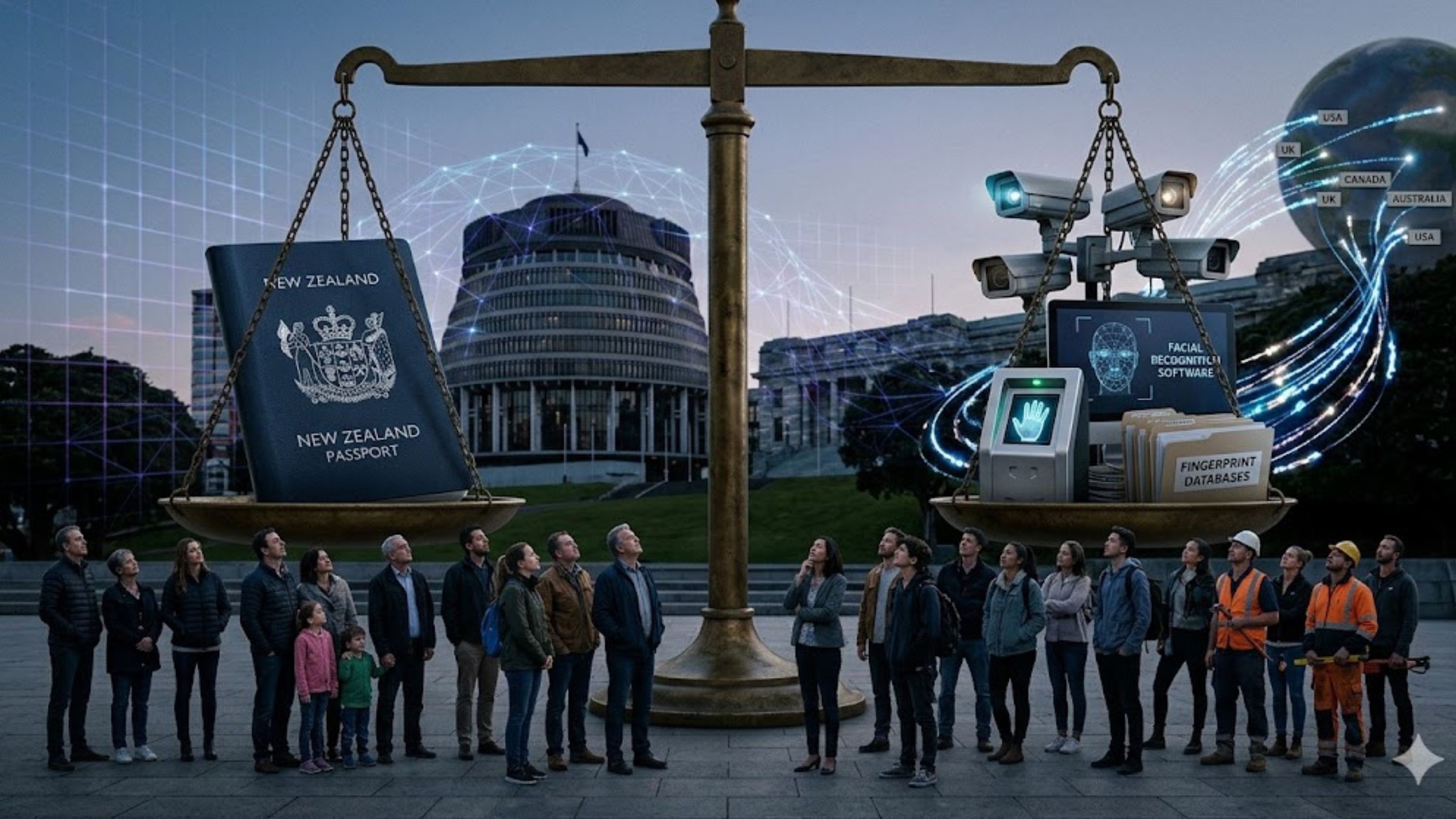
Chris Luxon tells us we make our own policy. But sovereignty isn’t just about what you say at a podium — it’s about what systems you plug yourself into.
New Zealand joined the Migration Five in 2009, an offshoot of the Five Eyes security framework. We became a member of the International Organization for Migration in 2003 — an organisation academics have described as a form of neoliberal governance that extends control beyond capital flows to the management of migrant bodies themselves.
In 2024, RNZ reported that the Migration Five now share biometric data of all travellers, allowing partner countries to access that data without needing to justify why. The agreements underpinning this system are obscure, can be altered without parliamentary approval, and are not meaningfully overseen by any independent watchdog.
The data shared includes family information, medical history, and travel records — covering 1.1 million New Zealand resident visa holders.
As one Canadian researcher bluntly put it, these systems resemble the FBI’s no-fly list: no clear accountability, no transparency, and no real mechanism for redress. Or, as the director of UK civil liberties group Statewatch said, they are systems that “don’t really comply with the rule of law… because they turn everyone into a suspect.”
What about privacy protections?
You might think our Privacy Act would protect us here.
It doesn’t.
The Immigration Act 2009 explicitly allows the collection and sharing of information with foreign governments as an exemption from domestic privacy protections. In other words, sovereignty stops where international security cooperation begins.
And what about political resistance to this erosion of migrant rights?
There isn’t much. In the UK, the Labour Party has abandoned any serious claim to defending migrants. In New Zealand, recent amendments to the Immigration Act passed with full Labour Party support.
So much for democratic opposition.
This didn’t come out of nowhere
None of this is accidental.
Since the 1980s, New Zealand has shifted from an immigration system that managed population and settlement to one that reduces people to economic units. We’ve created a class of “permanently temporary” migrants — useful, disposable, and perpetually insecure.
That shift has predictable consequences:
- rising fraud and exploitation,
- policies designed to control vulnerability rather than resolve it,
- and eventually, populist rhetoric that frames migrants as threats rather than people.
We’ve seen this pattern play out elsewhere. We are not immune to it.
So is MAGA-fication a real risk?
Yes. Not because New Zealand is suddenly becoming the United States, but because the same structural steps are being taken: data-driven suspicion, expanded enforcement powers, diminished legal protections, and a steady erosion of accountability — all justified in the language of “risk”, “security”, and “sovereignty”.
Selling out sovereignty in immigration policymaking doesn’t happen in one dramatic moment. It happens quietly, through agreements no one votes on, amendments few people read, and assurances that everything is under control.
Until it isn’t.
If history tells us anything, it’s that systems that dehumanise people in the name of efficiency eventually normalise cruelty. And once that happens, the slide accelerates.
The question isn’t whether New Zealand makes its own immigration policy.
It’s who that policy is really being made for — and who it’s being made against.
Immigration systems do not operate in a vacuum. When policy design prioritises control, surveillance, and deterrence over fairness and transparency, legal risk increases — not only for migrants, but for the integrity of the system itself.
This is where informed New Zealand immigration law advice becomes essential, especially as legislative changes quietly reshape enforcement powers without meaningful public scrutiny.
Conclusion: Why This Matters Beyond Migration
This debate is not just about immigration numbers or border control. It is about how power is exercised, how accountability is weakened, and how easily fear-based policy can be normalised.
Immigration Lawyers have responsibilities to look beyond slogans and press releases to examine how laws operate in practice who they protect, who they expose, and how quietly expanded powers can reshape a society.
The real question is not whether New Zealand sets its own immigration policy, but whether that policy continues to reflect fairness, proportionality, and respect for human dignity or whether those values are being traded away in the name of “risk management”.