Alastair McClymont | Immigration Principal, Righteous Law | 20 October 2026
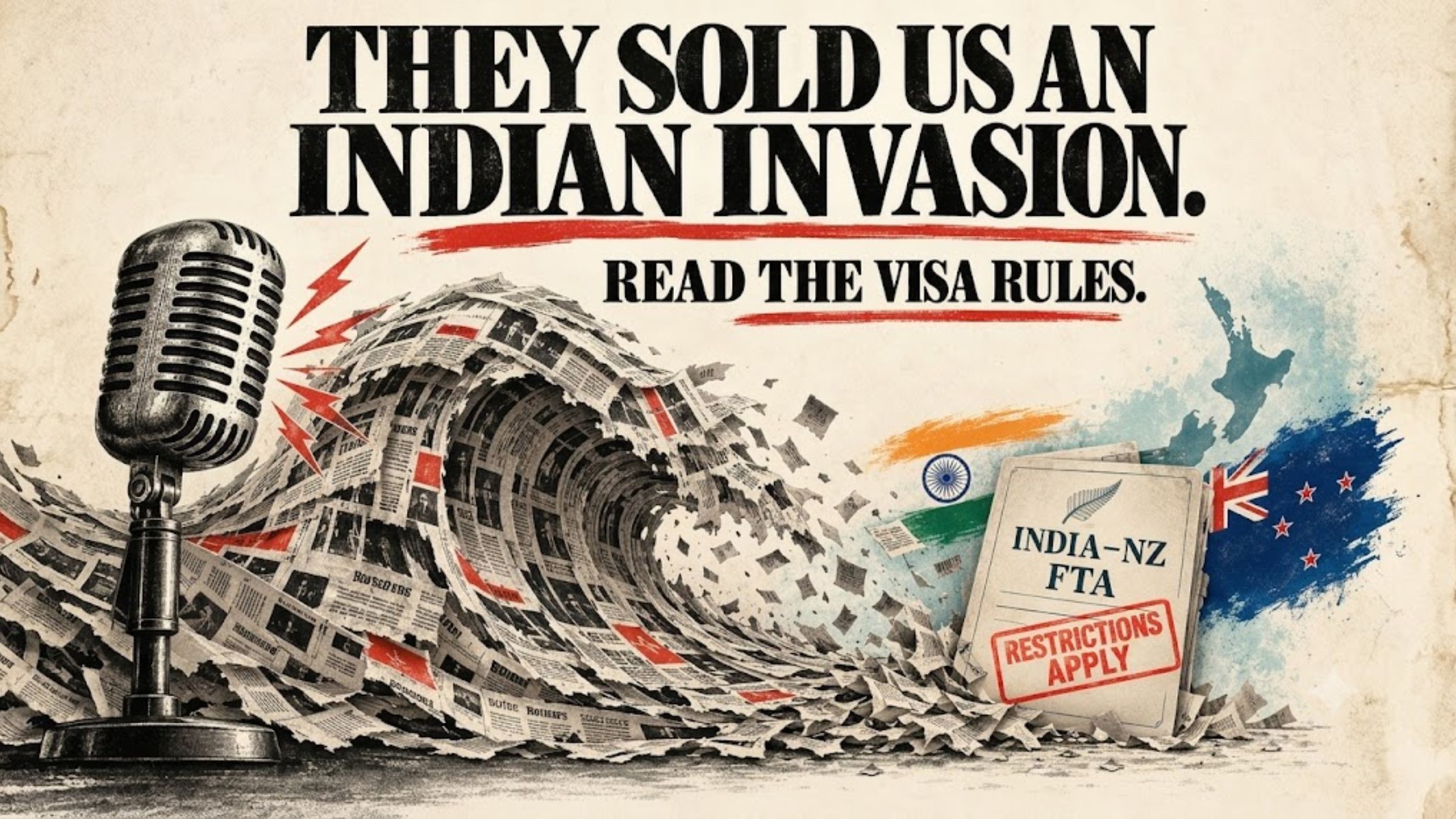
A “butter chicken tsunami”. A “flood of immigrants”. “Colonisation by stealth”.
That was the language used to sell New Zealanders a frightening story about the India Free Trade Agreement. Shane Jones supplied the racial caricature. Winston Peters supplied the flood. The Good Oil, hosted by Cam Slater, promoted its interview with Marewa Glover using the language of colonisation. [1–3]
Reality Check Radio helped build the campaign. Its submission material warned that New Zealand was locking the gates open. An article by Joshua Riley declared: “The door is ripped from its hinges and treaty-bound.” [4–5]
The intended impression was unmistakable. Indians were coming in large numbers, New Zealand had surrendered control, and ordinary New Zealanders would pay the price.
Now read the actual immigration rules.
The two new Indian employment visas deny holders the usual ability to support visas for their partners and children. The work they perform here cannot count towards skilled residence work-experience requirements. Their combined entitlement under these categories is three years, followed by three years outside New Zealand before another visa under either category. [6–7]
This is the supposedly irresistible invitation that was going to unleash an Indian invasion?
My prediction was that these arrangements would add almost nothing to Indian migration numbers. Having examined the implemented policy, I stand firmly by it. Actual uptake will take time to measure. But the rules confirm the central weakness in the scare campaign: these visas remove much of what would make the offer attractive to prospective migrants.
The racism was doing the work
There are legitimate arguments about immigration numbers, infrastructure, wages and trade agreements. None requires reducing Indian people to a curry dish.
When a senior minister describes prospective Indian workers as a tsunami, he invites his audience to imagine a destructive force. When a media outlet markets an FTA discussion as colonisation by stealth, it invites listeners to see Indians establishing lives here as participants in a hostile takeover.
I regard that framing as racist.
The problem goes beyond bad manners. It turns a nationality into a threat. A nurse becomes part of an influx. A family becomes a demographic danger. An Indian colleague, neighbour or business owner is made to answer for anxieties manufactured around people who look like them.
The people promoting these arguments cannot reasonably pretend their words stop at the studio door.
Indian New Zealanders hear them. So do people already looking for someone to blame for unemployment, housing costs or an overstretched hospital.
That is why this rhetoric is dangerous. It supplies respectable microphones for ugly prejudices.
Jones subsequently defended his use of hyperbole as a way of getting political attention. That admission deserves to follow every replay of his remarks. Indian people were being used to get attention. [8]
With an election approaching, the advantage to the campaigner is obvious. The cost falls elsewhere.
The right-wing media should answer for its own campaign
It would be convenient to dismiss this as another Shane Jones controversy. The commentary surrounding him deserves scrutiny too.
Reality Check Radio published material encouraging its audience to oppose the FTA and reproduce its arguments in submissions and public discussion. Among its claims were that Indian companies could bring unlimited workers and that New Zealand had locked itself into open immigration channels. [4]
Riley’s article presented temporary entry as a pipeline to permanent residence and voting rights. The Good Oil’s published episode description tied the agreement to demographic change, cultural threat and political infiltration. Those are the publishers’ own presentations of their material. [3, 5]
This was an organised argument about who belongs here and what Indian migration supposedly threatens.
Those outlets should now put the actual visa conditions before the same audiences, with the same energy they devoted to the scare.
They should explain the family restrictions. They should explain the exclusion of residence work experience. They should explain why someone seeking a settled future would choose these visas over existing alternatives.
Then they should explain why invasion imagery was necessary in the first place.
Who would choose this offer?
In nearly thirty years of immigration practice, I have advised many Indian clients for whom employment in New Zealand is part of a larger family plan.
They want to work, establish themselves, bring their children and qualify for residence. They are making decisions about their lives, often at considerable financial and personal cost.
The new FTA employment categories tell them: you can work here temporarily, but you cannot support the usual family visas, and this employment will not count towards the work-experience requirements for skilled residence.
Some people will still come for temporary earnings or overseas experience. But for many of the people most interested in migrating, the offer has been stripped of its principal attractions.
Meanwhile, Indian nationals remain eligible to apply under ordinary immigration policies. Where they meet the requirements, those routes can provide family support and employment that contributes towards residence. [9–10]
An Indian professional with a suitable job offer did not need the FTA to become eligible to apply.
Why choose the restrictive new category if an existing route better serves your family and your future?
That is the practical question missing from months of noisy commentary.
There is a genuine concession in removing the labour market test for these two categories. It may assist particular applicants and employers. But an easier route at one stage of the process does not establish a large increase in migration. [11]
Some FTA visa holders will be people who would otherwise have arrived under another policy. Their arrival cannot honestly be counted as migration created entirely by the agreement.
There is, however, one group to whom these visas offer an obvious opportunity: unscrupulous migration agents. A special visa negotiated for Indian citizens gives them a fresh sales pitch. My concern is that prospective applicants will be sold a dream of settlement, pay substantial fees and perhaps borrow against family assets, without understanding that the visa does not provide the usual family sponsorship rights or allow their work to count towards skilled residence experience.
The Government should anticipate that danger. Every promotion of these categories should give those restrictions the same prominence as the opportunities. Otherwise, an agreement portrayed to New Zealanders as an Indian invasion could be marketed to Indian workers as a pathway to a family future it does not provide. The politicians get their headlines, the dishonest agents get their fees, and the migrants carry the loss.
INZ still controls the decisions
The suggestion that New Zealand has handed India control of immigration is also difficult to reconcile with the powers INZ retains.
Applicants must satisfy the bona fide requirement. Officers can examine their financial circumstances, family ties, employment commitments and incentives to leave New Zealand. Occupational eligibility is no guarantee of approval. [12–13]
My concern is how that discretion can operate against Indian applicants. The economic attraction of working here can become an argument that someone lacks sufficient incentive to return home.
Nationality alone is not a lawful reason to decline an application. But subjective assessments about an applicant’s future intentions give INZ considerable power over whether the advertised opportunity becomes a visa.
Work-experience requirements provide another substantial filter.
A person may have done the work and still fail to produce evidence INZ considers adequate or independently verifiable. The new categories require prescribed experience for several occupations and supporting employment records. An applicant can therefore fail because INZ remains unsatisfied about the evidence, without any finding that the work was invented. [6–7]
I have previously criticised the August Skilled Migrant Category changes for the disadvantage this can impose on Indian applicants. INZ’s own explanation emphasised independently verifiable evidence and excluded self-employment from the two new residence pathways because the nature and skill of that work could be difficult to verify. [14]
These FTA categories reproduce the same problem wherever overseas experience is compulsory.
A promise of access means little to someone whose genuine employment history is rejected as insufficiently verifiable.
Peters cannot escape the question either
Peters eventually advanced a different argument.
Having warned that the FTA would permit excessive migration, he accused National of covertly introducing India-specific restrictions and withholding information because of the anticipated Indian reaction.
In Parliament, he identified the family restrictions, the exclusion of residence work experience and offshore application requirements. He called the alleged concealment bad faith. [15]
That raises a legitimate question: what did India understand it was receiving, and when was it told how restrictive the offer would be?
India’s High Commissioner subsequently said she did not believe New Delhi had been misled. We should not substitute Peters’s allegation for evidence of what the two governments agreed. [16]
Nor should we pretend the final October settings necessarily resolve every dispute about earlier proposals.
But that qualification cannot become a permanent escape hatch for those who promoted the scare. They must explain what they knew, when they knew it, and whether they corrected their audiences as the restrictions became clear.
If the Government diminished an offer it had presented more generously to India, that warrants scrutiny. If commentators misunderstood the system, they should acknowledge it. If they understood the limitations and promoted the invasion story anyway, their conduct deserves much harsher judgment.
We cannot establish private motives from public statements alone. We can hold people responsible for the statements they chose to make.
Where is the correction?
The wider agreement includes separate student, business-mobility and working-holiday commitments. Those deserve examination on their own terms. They do not create family or residence entitlements that these two employment categories expressly withhold. [17]
Individuals may still qualify independently for another visa or residence category. The FTA visas are not a lifetime prohibition on settlement. But neither are they the open invitation to family migration that the campaign encouraged New Zealanders to imagine.
My assessment is categorical: these two categories will contribute very little additional Indian migration. Their restrictions make them a poor proposition for many people seeking a permanent family future, while existing routes remain available to those who qualify.
The public was given a frightening picture of Indians arriving beyond our control. The policy offers a limited period of employment, subject to extensive conditions and INZ’s assessment.
The politicians and media figures responsible should explain that difference.
And they should do it publicly, to the audiences whose fears they cultivated.
Indian New Zealanders are entitled to live here without being turned into an election-season menace. Their children should not have to hear their community described as a disaster approaching the shore.
Those who helped create that atmosphere owe them more than silence.
Sources
[1] 1News, Jones’s comments and the Prime Minister’s response, 20 April 2026
[2] Winston Peters, An Election Like No Other, 28 June 2026
[3] The Good Oil, Episode 35 with Marewa Glover, June 2026, publisher’s description
[4] Reality Check Radio, New Zealand–India FTA submission campaign, 17 May 2026
[5] Joshua Riley, The India FTA The Worst Deal Parliament Never Read, 15 June 2026
[6] Immigration New Zealand, India Skilled Work Visa
[7] Immigration New Zealand, India Iconic Work Visa
[8] RNZ, Jones defends his comments, 21 April 2026, republished by Scoop
[9] Immigration New Zealand, Skilled Migrant Category Resident Visa
[10] Immigration New Zealand, Bringing family if you have a work visa
[11] Immigration New Zealand, Amendment Circular 2026–31, WI21 and WI22
[12] Immigration New Zealand, E5.10 Determining whether an applicant is a bona fide applicant
[13] Immigration New Zealand, Genuine intentions to visit or work in New Zealand
[14] Immigration New Zealand, Final details about SMC and work to residence changes, 18 June 2026
[15] Hansard, India FTA Bill first reading, Peters speech at 15:29, 25 June 2026
[16] Awaaz, India’s top diplomat rejects claim New Delhi was misled
[17] Immigration New Zealand, India–NZ FTA new visa commitments, 20 October 2026