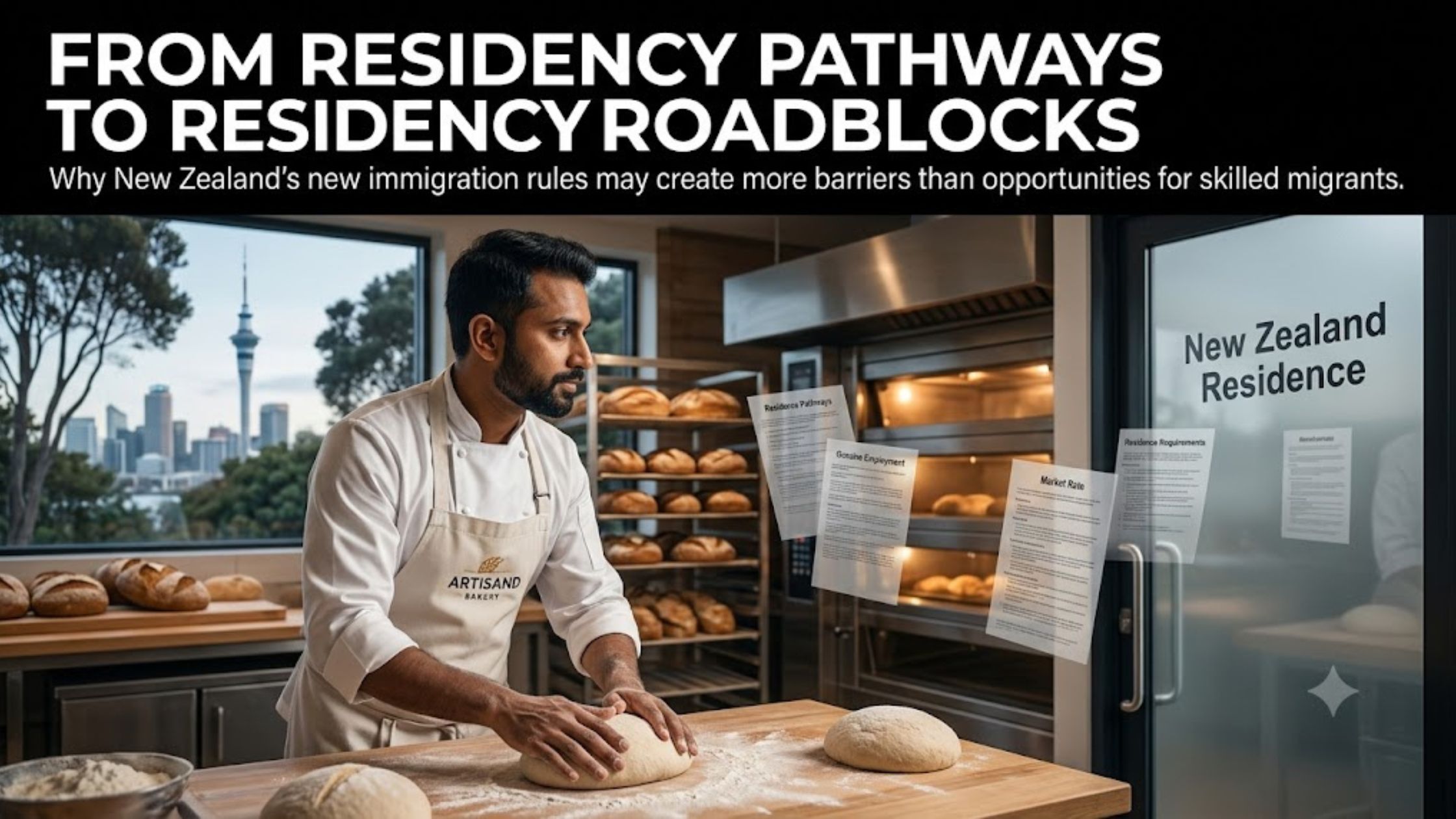
The Government says it has created two new pathways to skilled residence. What has received far less attention is that, for many occupations, those same changes may simultaneously create new barriers that make residence significantly harder to obtain.
This week I was interviewed by the Dominion Post regarding recent amendments to New Zealand’s immigration policy that may create significant new barriers to residence for skilled migrants.
The interview followed comments by Foreign Minister Winston Peters, who claimed the Government was quietly introducing immigration changes that would make residency more difficult for Indian nationals while avoiding political embarrassment during Indian Prime Minister Narendra Modi’s recent visit to New Zealand.
In response, Immigration Minister Erica Stanford maintained that new pathways to residence remain available across many occupations. On paper, that is true. The changes introduce two additional residence pathways alongside the existing Skilled Migrant Category and the Green List.
What has received far less attention is whether those pathways are genuinely accessible in practice.
More Pathways—or More Roadblocks?
The occupations most affected by the new settings are not randomly distributed across the labour market. They are concentrated in sectors that have traditionally relied heavily on temporary migrant labour, including hospitality, retail, personal services, business administration and ICT support.
Examples include:
- Baker
- Pastry Cook
- Chef
- Café and Restaurant Manager
- Hotel Manager
- Hotel Service Manager
- Office Manager
- Customer Service Manager
- Retail Manager
- ICT Customer Support Officer
- ICT Support Technician
- Web Administrator
- Hairdresser
- Beauty Therapist
- Hair and Beauty Salon Manager
- Massage Therapist
MBIE’s own research shows that Indian nationals make up New Zealand’s largest migrant workforce. It follows that if residence pathways become significantly more difficult within occupations that have historically relied on migrant workers, the practical effect is likely to fall disproportionately on migrants from India and the wider Indian subcontinent.
Rather than examining every occupation individually, it is easier to look at one example to see how the new policy operates in practice. Bakers provide a particularly clear illustration, but the same issues arise across many of the occupations listed above.
A Practical Example
On paper, a baker appears to have four possible pathways to residence:
- Green List
- Six-Point Skilled Migrant Category
- Skilled Work Experience Pathway
- Trades and Technicians Pathway
However, the Green List can immediately be discounted because bakers are not included.
The Trades and Technicians Pathway is also unavailable because bakers do not appear in Appendix 23 of Immigration New Zealand’s Operational Manual.
That leaves only two possible pathways.
Under the Six-Point Skilled Migrant Category, applicants generally need either a bachelor’s degree, registration in a regulated profession, or earnings of at least 1.5 times the median wage.
For most experienced bakers, the bachelor’s degree requirement presents an obvious obstacle. Baking is a trade rather than a university profession, making this pathway unrealistic for many applicants.
The remaining option is the new Skilled Work Experience Pathway, which requires five years of relevant skilled work experience and earnings of at least 1.2 times the median wage.
The Genuine Employment Contradiction
At first glance, the solution appears straightforward.
If an employer values an experienced worker, why not simply pay the salary required to qualify for residence?
The answer lies in another part of the policy.
The same policy changes also strengthen the requirement that offers of employment must be genuine.
When assessing whether employment is genuine, immigration officers are directed to consider whether the salary offered is consistent with market rates for that occupation.
This creates what appears to be a fundamental contradiction.
A baker seeking residence through the Skilled Work Experience Pathway may need to earn close to $110,000 per year.
Yet Government labour market information indicates that experienced bakers generally earn substantially less than this.
If an employer offers the salary necessary to meet the residence threshold, Immigration New Zealand may potentially conclude that the salary falls outside normal market rates and therefore question whether the employment itself is genuine.
In effect, the policy appears capable of requiring applicants to meet salary thresholds that may simultaneously become the basis for questioning the authenticity of the employment being relied upon to obtain residence.
That is not merely a difficult hurdle.
It has the potential to become an impossible one.
A Systemic Issue
The baker example is important only because it illustrates a much broader issue.
The same interaction between salary thresholds and the revised “genuine employment” provisions has the potential to affect chefs, hospitality managers, office managers, retail managers, ICT support occupations, beauty therapists, hairdressers and a range of other occupations that have historically provided realistic pathways to residence.
These are also occupations that have long relied on temporary migrant labour.
The consequence may be that skilled workers who have lived and worked in New Zealand for many years, paid taxes, supported local businesses and filled genuine labour shortages find themselves unable to qualify for residence despite doing everything the immigration system has asked of them.
Instead, they may remain trapped in an ongoing cycle of temporary visas, unable to establish the long-term security that residence was once intended to provide.
Policy Mistake or Policy Choice?
Whether these consequences are intentional or simply an unintended result of policy design remains open to debate.
It would be wrong to assume motive without evidence.
However, it is difficult to ignore the coincidence that, at the very time Winston Peters publicly claimed the Government was creating new barriers to residence for Indian migrants, Immigration New Zealand released policy amendments that appear capable of producing precisely that effect.
Whatever the Government’s intentions, immigration policy should not contain internal contradictions that require applicants to meet salary thresholds which may then become grounds for questioning whether their employment is genuine.
If New Zealand genuinely wishes to provide skilled migrants with pathways to residence, those pathways must be real.
Otherwise, what are described as new residency pathways risk becoming little more than residency roadblocks.