“The outrage over the Migrant Workers Association’s mock guillotine misunderstands one of the oldest traditions in Western democracy: symbolic public political theatre.”
“It has no place in a democracy.”
That was the unmistakable message behind much of the reaction to the Migrant Workers Association of Aotearoa’s symbolic guillotining of Winston Peters. Peters reportedly suggested those responsible should be arrested. To many commentators, the protest represented an abandonment of democratic norms, replacing legitimate political debate with intimidation and implied violence.
I believe that criticism has history almost entirely backwards.
The question is not whether the protest was tasteful. Political theatre rarely is, and people are perfectly entitled to find it offensive or politically counterproductive. The real question is whether symbolic public theatre of this kind belongs within the democratic tradition at all. History suggests that it does. Indeed, it has been one of the defining features of democratic politics for more than two centuries.
Before explaining why, I should acknowledge my own perspective. Over many years as an immigration lawyer I have worked alongside and supported the Migrant Workers Association in its efforts to improve the treatment of migrant workers in New Zealand. I have enormous respect for the organisation and much of what it has achieved. For well over a decade it has been one of New Zealand’s most effective civil society organisations, exposing migrant exploitation, advocating for fairer immigration laws and playing an important role in the campaign that ultimately led to the Government’s introduction of the 2021 One-off Resident Visa. Whether one agrees with all of its politics is beside the point. It is an established organisation with a long record of democratic advocacy, not a fringe movement that suddenly appeared last weekend.
Modern democracies instinctively associate political participation with elections, parliamentary debate, newspapers, television and social media. Yet those institutions are comparatively recent. For much of the history of representative government, ordinary people had no newspaper columns, no broadcasting licences and no digital platforms. If they wished to condemn kings, ministers or governments, they did so publicly, through symbolism, performance and spectacle.
Before democracy had newspapers, it had streets.
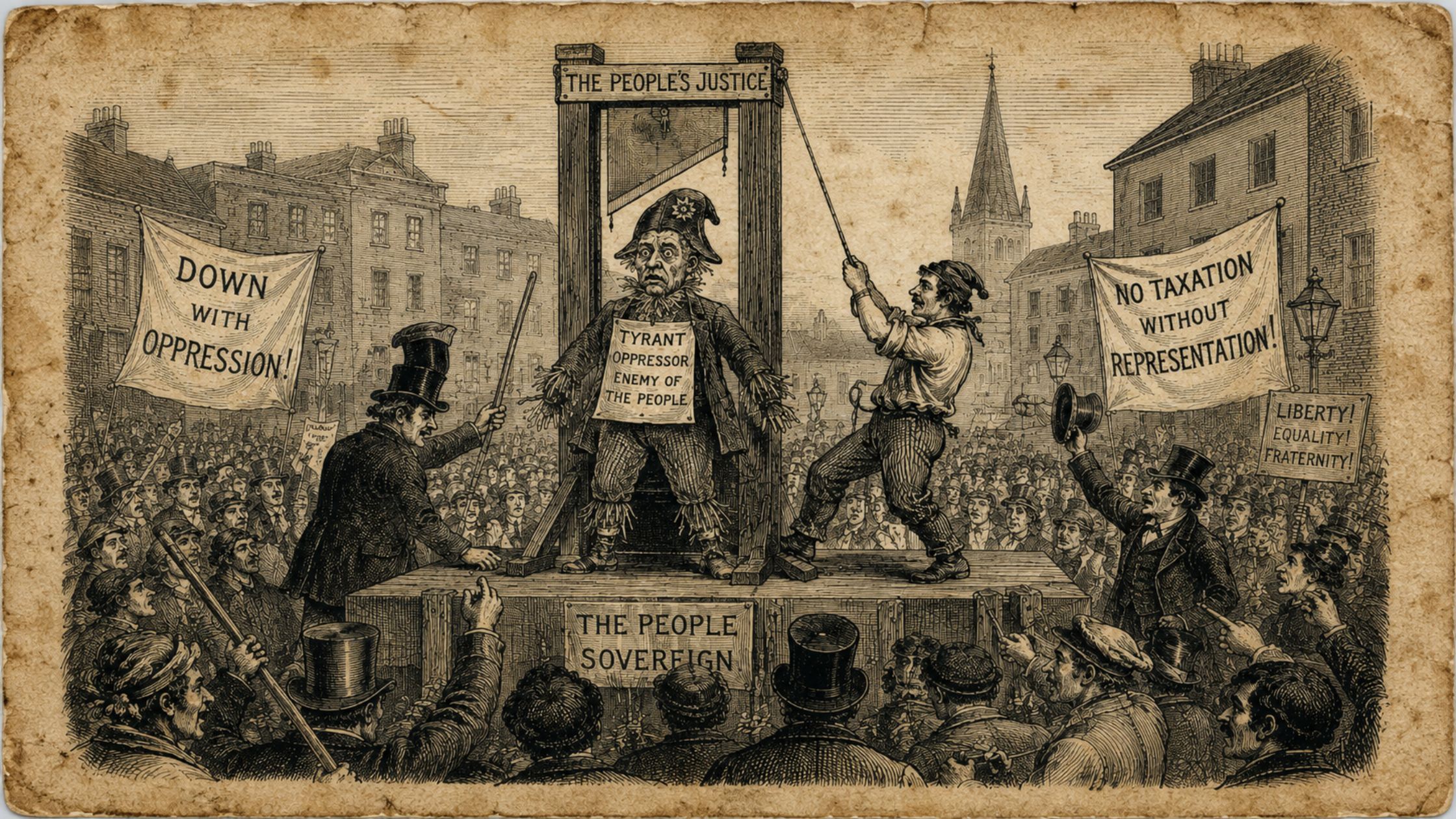
Politics was not simply argued; it was performed. Processions became political arguments. Effigies became editorial cartoons. Mock trials became public commentary. Symbolic executions became vivid declarations that those exercising authority had lost their moral legitimacy.
Modern historians increasingly recognise these performances as an established language of democratic dissent. Florian Göttke, whose work on political effigies is among the most comprehensive studies of the subject, describes the hanging and burning of effigies as a “well-established genre” of political protest. These rituals drew on older traditions of carnival and public justice, where communities dramatised their moral judgement through symbolic rather than literal punishment.
Britain provides some of the clearest examples. Throughout the eighteenth century, crowds regularly constructed effigies of unpopular ministers, tax collectors and public officials. These figures were paraded through towns and cities before being ceremonially hanged, burned or otherwise symbolically punished before large audiences. The events combined speeches, music, banners and humour. Their purpose was not to organise assassinations. Their purpose was to communicate political judgement in the most public way imaginable.
An important study of radical politics in the 1790s describes mock executions, paraded effigies and symbolic beheadings as central features of British popular political culture. In an era when political participation was limited, public theatre allowed ordinary people to express approval or condemnation of those who governed them.
Across the Channel, the French Revolution transformed this language forever. Although the guillotine was a real instrument of execution, it quickly became something more powerful: a political symbol. Over time it ceased to represent simply death and came instead to represent the removal of authority itself.
That symbolic transformation survives in everyday language. Ministers are “for the chop”. Chief executives “get the chop”. Newspapers predict that “heads will roll”. Nobody imagines literal executions. We instinctively understand these expressions as metaphors for dismissal, accountability and the temporary nature of political power.
The symbolic guillotine belongs to exactly the same family of political imagery. Its message is not necessarily that someone should die. Its message is that someone should no longer govern.
Nor was this tradition confined to Europe. Colonial America inherited Britain’s traditions of public political theatre. During protests against the Stamp Act, the Sons of Liberty famously hanged tax officials in effigy before large crowds. Mock funerals, symbolic punishments and public spectacles became familiar features of political life both before and after independence. American democracy inherited this theatrical language; it did not reject it.
That history should give us pause before concluding that symbolic political theatre somehow lies outside the democratic tradition. For much of democratic history, public performance was one of the principal ways ordinary citizens challenged those who exercised power.
The distinction between symbolic political theatre and genuine threats has also shaped modern constitutional law.
In 1969 the United States Supreme Court considered the case of Robert Watts, an eighteen-year-old protesting the Vietnam War. At a political rally he declared that if he were forced to carry a rifle, “the first man I want to get in my sights is L.B.J.” On its face, the statement described shooting the President of the United States. Yet the Supreme Court unanimously overturned his conviction, recognising that political debate is often, in its words, “vehement, caustic, and sometimes unpleasantly sharp.” The Court distinguished genuine threats from “political hyperbole”—the exaggerated, provocative language that has always accompanied democratic politics.
That distinction remains fundamental. Democracies have never required political expression to be polite. They have required it not to become genuine violence or genuine intimidation. Symbolic political theatre has always occupied that uncomfortable space between offence and freedom.
Those of us who grew up in the early 1980s encountered the same tradition in popular culture. Punk thrived on provocation. The Dead Kennedys’ Kill the Poor appeared, from its title alone, to advocate something monstrous. In reality it was savage political satire, exposing elite indifference by pretending to embrace it. The shock was the mechanism through which the political point was made.
Britain’s political culture produced similar examples during the Thatcher years. The Beat urged listeners to Stand Down Margaret. Elvis Costello imagined standing over Thatcher’s grave in Tramp the Dirt Down. Morrissey’s Margaret on the Guillotine became one of the most controversial political songs of its era. Across the Atlantic, Ronald Reagan appeared in equally provocative punk posters, artwork and satire.
Few people seriously believed these artists were organising political assassinations. They recognised the performances for what they were: symbolic acts of political dissent, drawing on the same tradition that had once produced effigy burnings, mock trials and public processions through the streets of London, Paris and Boston.
The tradition extends well beyond music. Editorial cartoonists have long portrayed politicians on gallows, beneath guillotines or marching towards symbolic execution. Protesters have carried coffins representing unpopular governments. Trade unions have staged mock funerals for public policies. Demonstrators have hanged presidents, prime ministers and monarchs in effigy throughout the democratic world. These images are often controversial and sometimes offensive, but they form part of a remarkably consistent political vocabulary stretching back centuries.
None of this means every use of execution imagery is beyond criticism or beyond the reach of the law. Context matters. A symbolic performance in a public protest is very different from conduct intended to terrorise a particular individual. Mature democracies are capable of recognising that distinction.
Which brings us back to Winston Peters.
Many New Zealanders, myself included, regarded his “go back to your own country” remarks directed at Green MP Lawrence Xu-Nan as racist and inconsistent with an inclusive vision of New Zealand democracy. Others disagreed. That disagreement is itself part of democratic politics and is not the subject of this article.
The irony lies elsewhere.
Mr Peters has consistently presented himself as a defender of democratic values. Yet when confronted by one of democracy’s oldest forms of symbolic public protest, he appeared to suggest that it somehow lay outside the democratic tradition altogether. History suggests precisely the opposite.
The Migrant Workers Association’s mock guillotine did not emerge from nowhere. It belongs to a political language that has evolved over centuries—a language of effigies, mock trials, satirical songs, editorial cartoons and symbolic public performance through which ordinary citizens have challenged those who hold power.
People are perfectly entitled to dislike that language. They may regard it as crude, offensive or politically counterproductive. Those are legitimate criticisms.
What they should not do is imagine that symbolic political theatre is somehow foreign to democracy.
For centuries, democracy has spoken in two voices. One belongs to Parliament and the other belongs to the street.
Parliament debates, legislates and governs. The street performs a different function. It dramatises public anger, celebrates public victories, ridicules public failures and reminds those who govern that authority ultimately rests not with governments but with citizens.
The mock guillotine in Auckland will eventually be packed away. This week’s headlines will fade. Winston Peters will one day leave public life, as every politician eventually does.
What will remain is something much older.
For more than 250 years, Western democracies have allowed ordinary citizens to speak back to power not only through ballots and speeches but through symbols, satire, music, caricature and public performance. Sometimes that performance has taken the form of a song. Sometimes an editorial cartoon. Sometimes an effigy hanging from a gallows. Sometimes a mock guillotine in a city square.
Those traditions are not an embarrassment to democracy, they are among its oldest expressions. Perhaps that is the greatest irony of this week’s controversy.
The politician who claimed to be defending democracy was condemning one of democracy’s oldest forms of public speech.
Alastair McClymont is a veteran Immigration Lawyer still practising in Auckland as Immigration Principal of Righteous Law.